a founder of the codex
Petrification
Lithomorpha fidelis·the Faithful Stone
From Greek lithos, stone, and morphe, form, and Latin fidelis, faithful, the stone that keeps a living form faithfully.
- Level
- Conceptorganism
- Phylum
- Part and wholeimage schema
- Class
- Decayits conchoidal fracture
- Niche
- Parasitethe mechanism of a host idea
- Mode
- Referencehow it keeps existing
- Stage
- Matureindividuated
- Status
- Living
- Habitat
- Archive
Its kinds · Roget, 1852: Change · Wilkins, 1668: Stone · WordNet, 1990: Process · Llull, 1308: I · Elementative
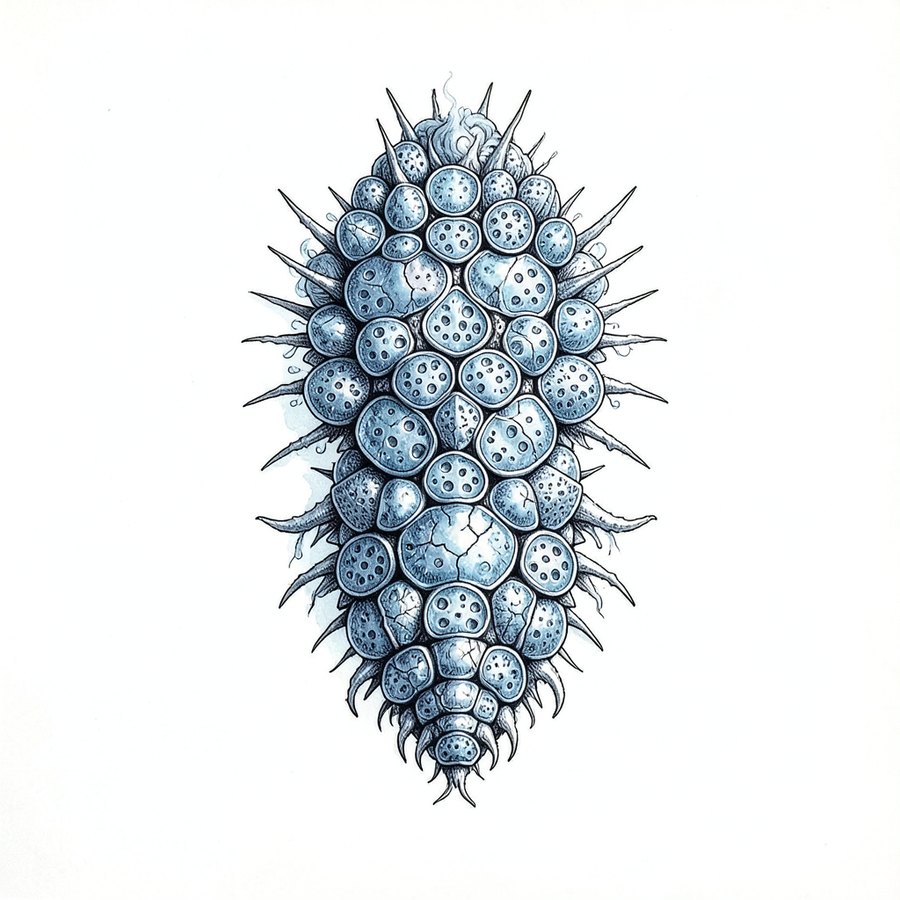
Petrification replaces a living body with stone, grain by grain, so its form outlasts its matter and stays exact and rigid until it shatters.
A form can outlive every grain of the body that held it, and what it gains in permanence it pays for in brittleness.
behavior It works unseen for ages under mud and water, keeps every cell of what it takes, and splits apart at the first hard blow.
Which belief of yours has kept its shape so long that it can only break?
I Dissection
Each organ answers one question about the idea. The framed one, its decay, is the dominant organ: the being's class, the one the idea could not lose and stay itself.
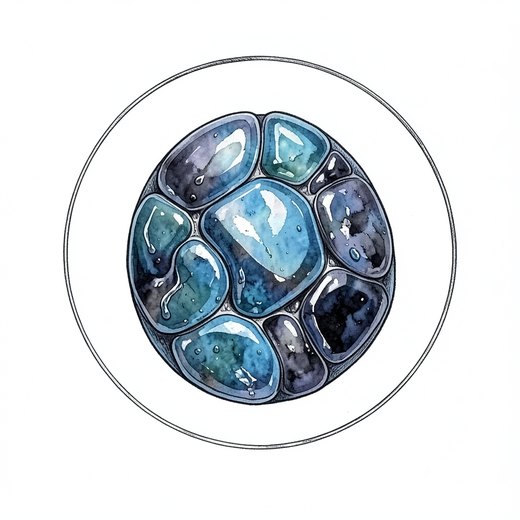
Fig. 1. Kernel
Pseudomorph
Which premise, if it were false, would kill this idea?
A form can outlast its matter. In petrification every part of a buried body is replaced by mineral, and its shape and even its cells are kept.1, 2
drawn as: pseudomorph · view: microscope
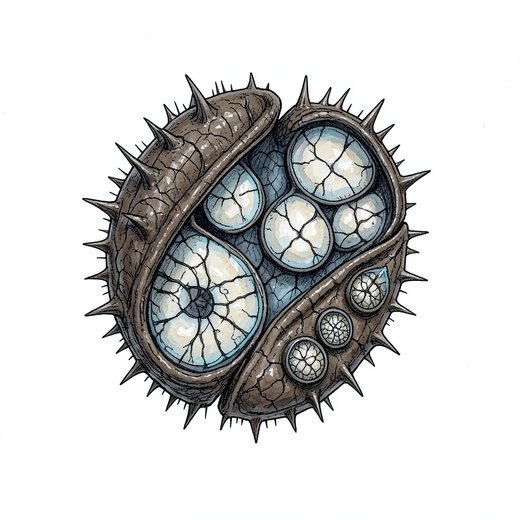
Fig. 2. Boundary
Rapid burial
What sets it apart from what it is not, and how does it keep that distinction?
It begins where a body is buried fast in mud, sand or volcanic ash and sealed from the air before rot can take it.3
drawn as: rapid burial · view: cast
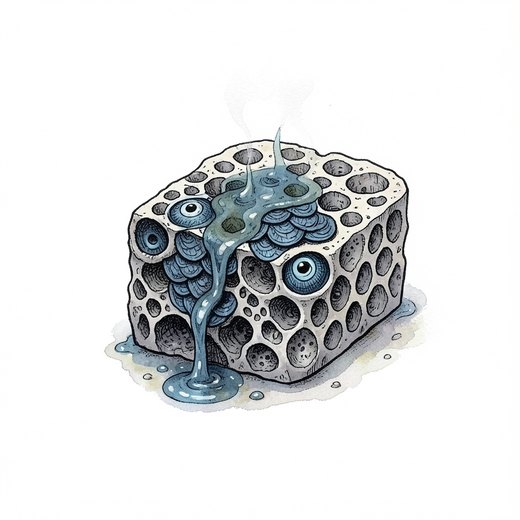
Fig. 3. Intake
Groundwater
What must it feed on to work? What has to be present, noticed or supplied?
It feeds on groundwater carrying dissolved silica, calcite or iron, which seeps through buried wood and bone, the silica often leached from volcanic ash above.4
drawn as: groundwater · view: at work
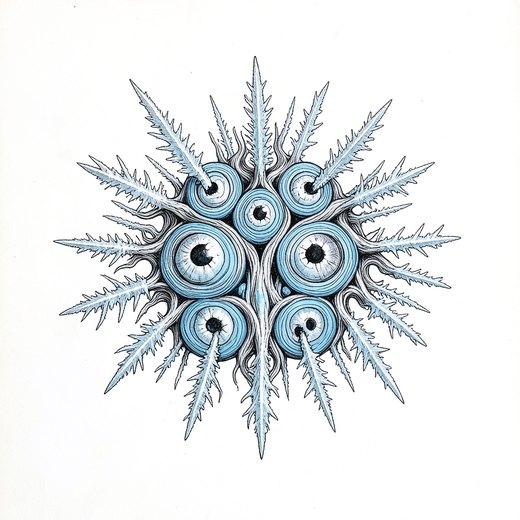
Fig. 4. Mechanism
Permineralization
How does it turn what it takes in into what it gives out?
Mineral first fills the pores and cell spaces, then takes the place of the cell walls themselves as they dissolve, so stone copies the tissue down to its cells.4, 2
drawn as: permineralization · view: detached
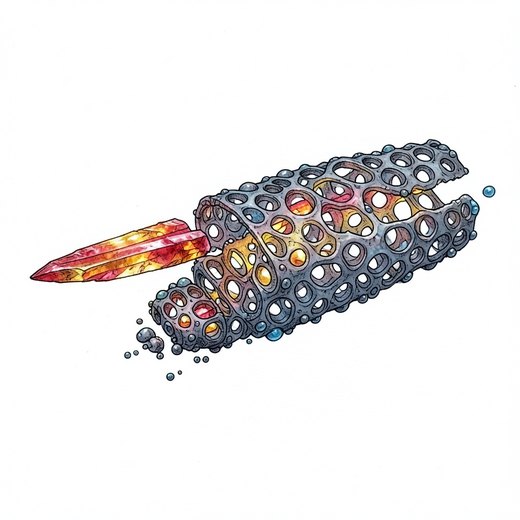
Fig. 5. Output
Agatized wood
What does it make possible, visible or knowable?
It turns forests into stone logs whose growth rings show in bands of red and yellow quartz, and it keeps bones and shells whole for hundreds of millions of years.2, 4
drawn as: agatized wood · view: exploded
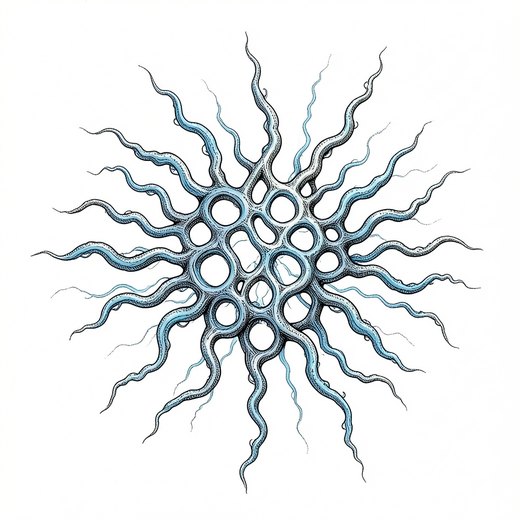
Fig. 6. Dispersal
Gorgon
What part of it travels into other minds, ideas and fields, and by what vector?
It travels in myth as the Gorgon whose gaze turns the living to stone and the grieving mother turned into a rock that weeps on, and in speech as fear that freezes a body in place.5
drawn as: Gorgon · view: series
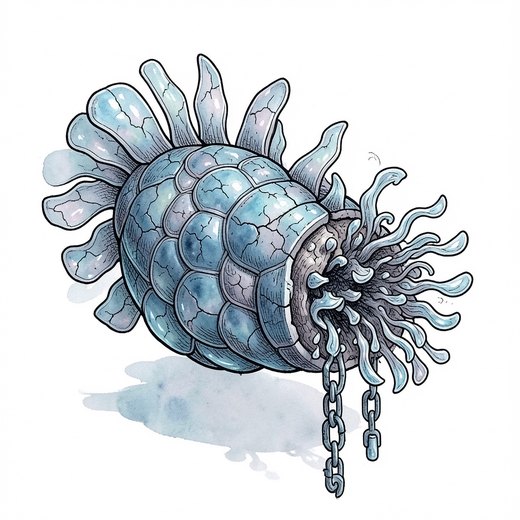
Fig. 7. Decay
Conchoidal fracture
❦ dominant organWhat can it not digest, where does it fail, and what does it leave behind for others?
Turned to quartz, it keeps its form and loses all give. Under strain it cracks across into even segments, and a sharp blow shatters it into curved flakes.4
drawn as: conchoidal fracture · view: magnified
II Meaning associations
No relations recorded yet.
descent membership food web resemblance or friction
Lineage
A founder, dissected by hand.
Kin
same kind in Roget Awakening, Entropy, Metamorphosis, Threshold, Tongue Horizon
same kind in Wilkins Amber, Ash, Clay, Diamond, Salt, Sand
same kind in WordNet Awakening, Breath, Entelechy, Entropy, Erosion, Fire, Metamorphosis, Rushmaker, Shared Breath, Self-Ending Order, Tongue Horizon, Witnessed Relief, Gazeroot (second reading), Commemorative Revision, The Swing Door
same kind in Llull Amber, Archipelago, Ash, Clay, Cloud, Diamond, Emergence, Entanglement, Entropy, Erosion, Fire, Frost, Iridescence, Lake, Rain, Reflection, Resonance, Resonance (second reading), River, Salt, Sand, Storm, Weightlessness, Wind, Winter, Self-Ending Order
same phylum Chimera, Emergence, Pointillism, Syllable, Babelhum, Subtractive Phenomenology
Genome
- replacement
- form also in Commemorative Revision, Entelechy, Metamorphosis, Poetry, Ritual
- fixity also in Salt
- record
- brittleness
III In the world
Echoes
- the Petrified Forest of Arizona
- the Gorgon's head on Athena's shield
- a dinosaur bone turned to opal
- a body frozen still by fear
IV Record
How it was drawn
its draw 4, a point in the morphospace (laws §8), drawn by flux-2-klein-4b.safetensors.
| axis | value | |
|---|---|---|
| book | uranographia | |
| symmetry | bilateral | |
| organization | segmented | |
| silhouette | cluster | |
| scale | immense | |
| proportion | elongated latent | |
| growth | encrusted | |
| articulation | jointed latent | |
| openness | solid latent | |
| skeleton | exoskeleton | |
| locomotion | walking latent | |
| pattern | reticulate latent | |
| coloration | disruptive latent | |
| substance | smoke | |
| surface | scaled | |
| palette | ink | |
| luminosity | sheen | |
| transparency | layered latent | |
| gesture | hardens | |
| unity | composite | |
| modality | necessary | |
| causation | formal latent | |
| determinacy | doubled latent | |
| fusion | built of | |
| anomaly | false shadow | |
| graft | none | |
| technique | stipple | |
| viewpoint | above | |
| value | low key latent | |
| balance | grounded latent | |
| density | intricate latent | |
| rhythm | unmarked latent | |
| saturation | unmarked latent | |
| appendages | spines, petals | |
| anchor (body) | sea sparkle, plankton flashing blue wherever the water is disturbed | |
| anchor (detail) | a diatom, a glass shell in two halves perforated with ordered pores |
Sources
- Nicolaus Steno, De solido intra solidum naturaliter contento dissertationis prodromus (1669)
- Robert Hooke, Micrographia (1665), observation 17, on petrified wood
- I. A. Efremov, Taphonomy: A New Branch of Paleontology (Pan-American Geologist, 1940)
- Richard F. Leo and Elso S. Barghoorn, Silicification of Wood (Botanical Museum Leaflets, Harvard University, 1976)
- Ovid, Metamorphoses (8 CE), books 4 to 6, on the Gorgon and on Niobe
❦