a founder of the codex
Iridescence
Stratochroa versans·the Shifting Lustre
From Latin stratum, a layer, and Greek chroa, colour, and Latin versans, turning, a colour made of layers that turns as it is seen.
- Level
- Conceptorganism
- Phylum
- Scaleimage schema
- Class
- Outputits gorget
- Niche
- Producerraw experience
- Mode
- Metamorphosishow it keeps existing
- Stage
- Matureindividuated
- Status
- Living
- Habitat
- Ocean
Its kinds · Roget, 1852: Organic Matter · Wilkins, 1668: Sensible Quality · WordNet, 1990: Phenomenon · Llull, 1308: I · Elementative
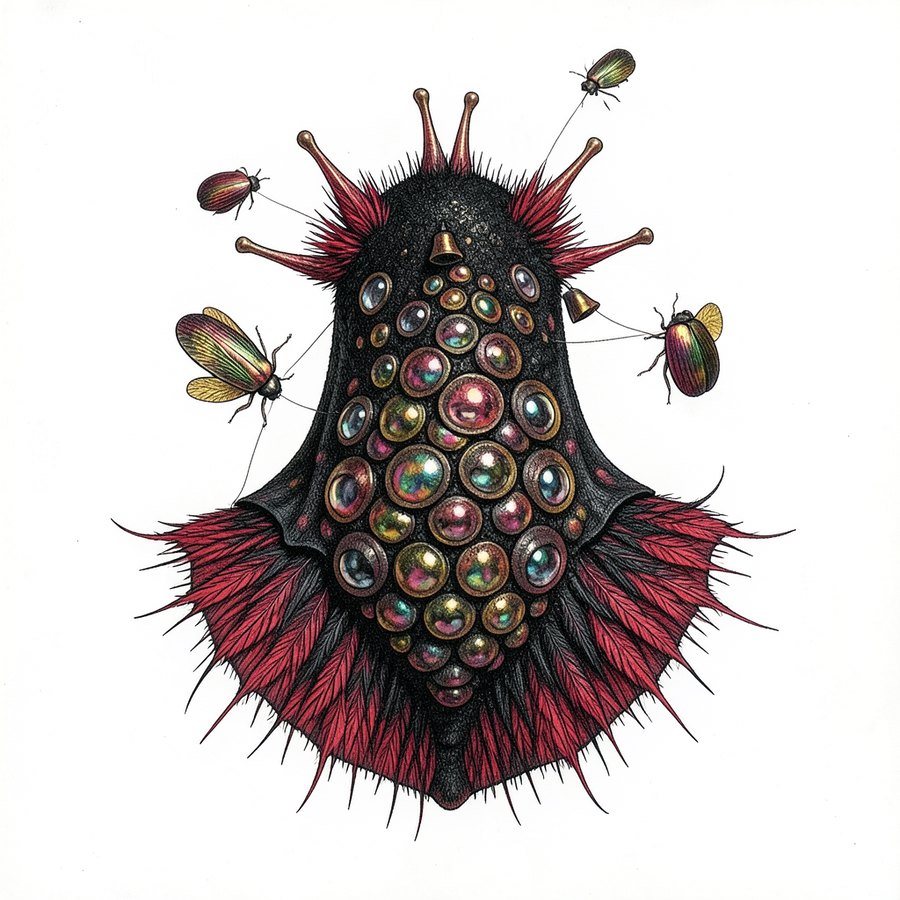
Iridescence is colour made by fine layers that send light back in step, so it changes with the angle of sight and dies when the layers lose their order.
Colour can live in structure and in the angle of a gaze, and it changes each time the eye or the body moves.
behavior It flashes and darkens as it turns, shows a different colour to every watcher, and goes dull brown when crushed.
Which of your colours change with where someone stands?
I Dissection
Each organ answers one question about the idea. The framed one, its output, is the dominant organ: the being's class, the one the idea could not lose and stay itself.
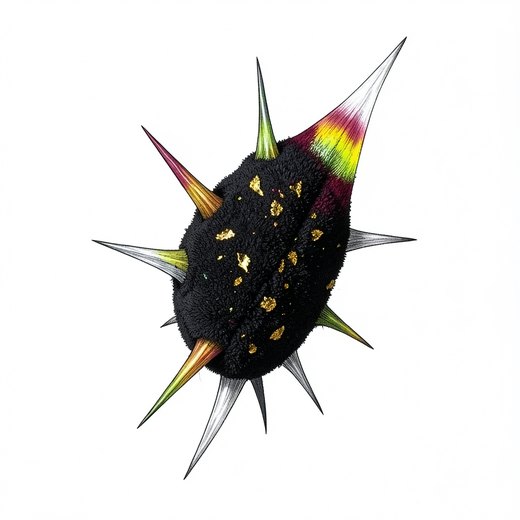
Fig. 1. Kernel
Thin film
Which premise, if it were false, would kill this idea?
Colour can come from structure alone. Light reflected from layers about as thin as its own wavelength adds up in some colours and cancels in others.2, 1
drawn as: thin film · view: series
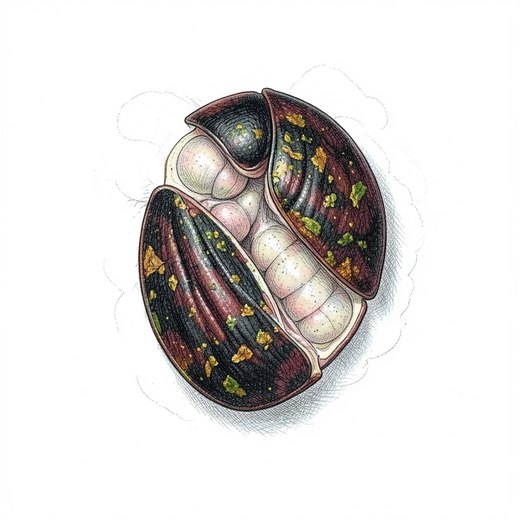
Fig. 2. Boundary
Pigment
What sets it apart from what it is not, and how does it keep that distinction?
It is set apart from pigment by the angle of view. Pigment shows one colour from every side, and this colour slides through the spectrum as the eye or the light moves.1
drawn as: pigment · view: at work
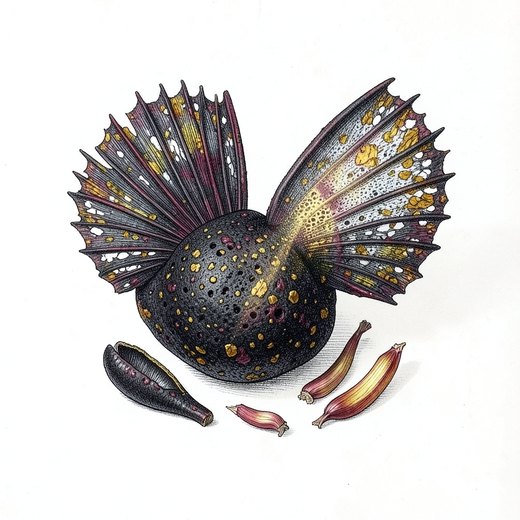
Fig. 3. Intake
Raking light
What must it feed on to work? What has to be present, noticed or supplied?
It needs white light falling from one side and an eye or a body that moves, since its colour lives in the angle between them.3
drawn as: raking light · view: pinned
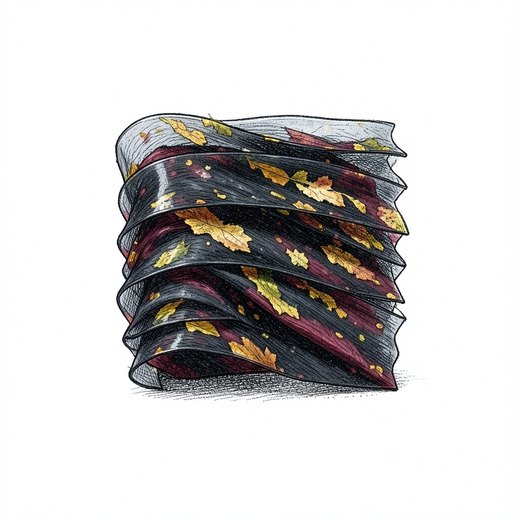
Fig. 4. Mechanism
Multilayer reflector
How does it turn what it takes in into what it gives out?
Each thin layer reflects a little light, and the reflections reinforce the colour whose waves fall in step. Seen at a slant, the path between layers shortens and the colour moves toward blue.3, 2
drawn as: multilayer reflector · view: transparent
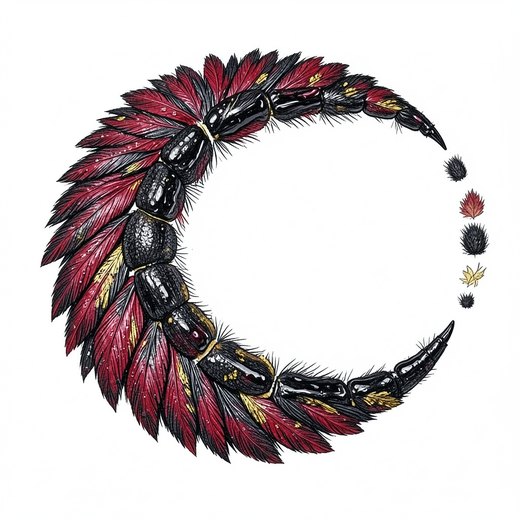
Fig. 5. Output
Gorget
❦ dominant organWhat does it make possible, visible or knowable?
It makes signals that flash with every turn. A hummingbird's throat blazes red from one side and goes black from another, and a morpho's wings flash blue across a clearing.4, 3
drawn as: gorget · view: exploded
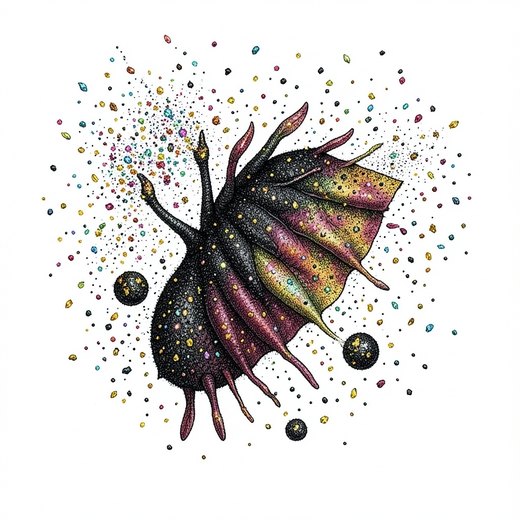
Fig. 6. Dispersal
Peacock's tail
What part of it travels into other minds, ideas and fields, and by what vector?
It travels into thought as a sign of change. Alchemists named the stage when the matter in the flask showed every colour the peacock's tail, a herald of the stone.5
drawn as: peacock's tail · view: in situ
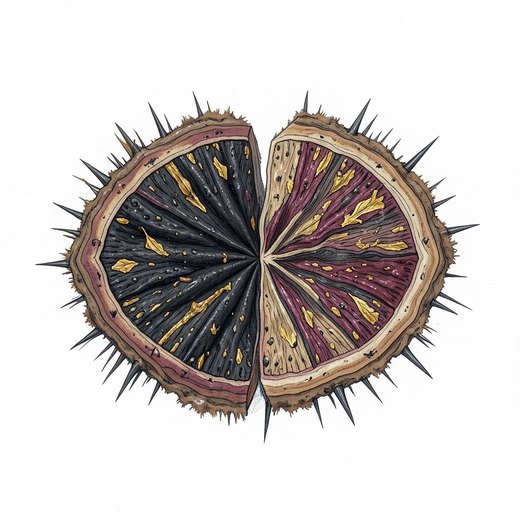
Fig. 7. Decay
Worn plumage
What can it not digest, where does it fail, and what does it leave behind for others?
It fails where its layers lose their order. Wet, crushed or worn, a feather or a wing goes dull, and the brown of its pigment is what remains.3
drawn as: worn plumage · view: cross section
II Meaning associations
No relations recorded yet.
descent membership food web resemblance or friction
Lineage
A founder, dissected by hand.
Kin
same kind in Roget Amber, Breath, Chiaroscuro, Chimera, Entelechy, Music, Silence, Tinnitus, Vertigo, Shared Breath
same kind in Wilkins Aura, Chiaroscuro, Qualia
same kind in WordNet Emergence, Frost, Placebo, Rain, Reflection, Resonance, Resonance (second reading), Storm, Wind
same kind in Llull Amber, Archipelago, Ash, Clay, Cloud, Diamond, Emergence, Entanglement, Entropy, Erosion, Fire, Frost, Lake, Petrification, Rain, Reflection, Resonance, Resonance (second reading), River, Salt, Sand, Storm, Weightlessness, Wind, Winter, Self-Ending Order
same phylum Entropy, Frost, Patience, Sand, Silence, Trance, Hesychology
same dominant organ Apophenia, Awakening, Chiaroscuro, Echolalia, Emergence, Erosion, Glossolalia, Mimesis, Nostalgia, Placebo, Rain, Spring, Babelhum, Afterlistening, Tide of Days
Genome
- layer
- angle
- interference
- display
- shimmer
III In the world
Echoes
- a peacock's train
- the inside of an abalone shell
- oil on a wet road
- a soap bubble drifting in the sun
IV Record
How it was drawn
its draw 2, a point in the morphospace (laws §8), drawn by flux-2-klein-4b.safetensors.
| axis | value | |
|---|---|---|
| book | mycelia | |
| symmetry | tessellated | |
| organization | segmented | |
| silhouette | bell | |
| scale | hand | |
| proportion | swollen latent | |
| growth | swelling | |
| articulation | jointed | |
| openness | hollow latent | |
| skeleton | spicules latent | |
| locomotion | rolling latent | |
| pattern | rosettes latent | |
| coloration | cryptic | |
| substance | spore dust | |
| surface | iridescent | |
| palette | obsidian | |
| luminosity | sheen | |
| transparency | translucent latent | |
| gesture | emits | |
| unity | fragment latent | |
| modality | unmarked latent | |
| causation | efficient | |
| determinacy | crisp latent | |
| fusion | sprouting | |
| anomaly | orbiting | |
| graft | mirrors | |
| technique | hatching | |
| viewpoint | above | |
| value | high key latent | |
| balance | leaning latent | |
| density | unmarked latent | |
| rhythm | unmarked latent | |
| saturation | accent latent | |
| appendages | bells | |
| anchor (body) | a nudibranch, a soft slug crowned with clusters of bright cerata | |
| anchor (detail) | beetle wing cases, hard, iridescent and finely ridged |
Sources
- Isaac Newton, Opticks (1704), book 2, on the colours of thin plates and of peacock feathers
- Thomas Young, On the Theory of Light and Colours (Philosophical Transactions, 1802)
- Pete Vukusic and J. Roy Sambles, Photonic Structures in Biology (Nature, 2003)
- Charles Darwin, The Descent of Man, and Selection in Relation to Sex (1871)
- C. G. Jung, Psychology and Alchemy (1944), on the cauda pavonis
❦