a founder of the codex
Breath
Pneumatophora alternans·the Turn-Taking Bellows
From Greek pneuma, breath, and phoros, bearing, and Latin alternans, taking turns; the bearer of breath that takes turns with the air.
- Level
- Conceptorganism
- Phylum
- Cycleimage schema
- Class
- Dispersalits spirit
- Niche
- Symbionta partner
- Mode
- Reproductionhow it keeps existing
- Stage
- Matureindividuated
- Status
- Living
- Habitat
- Body
Its kinds · Roget, 1852: Organic Matter · Wilkins, 1668: Corporeal Action · WordNet, 1990: Process · Llull, 1308: H · Vegetative
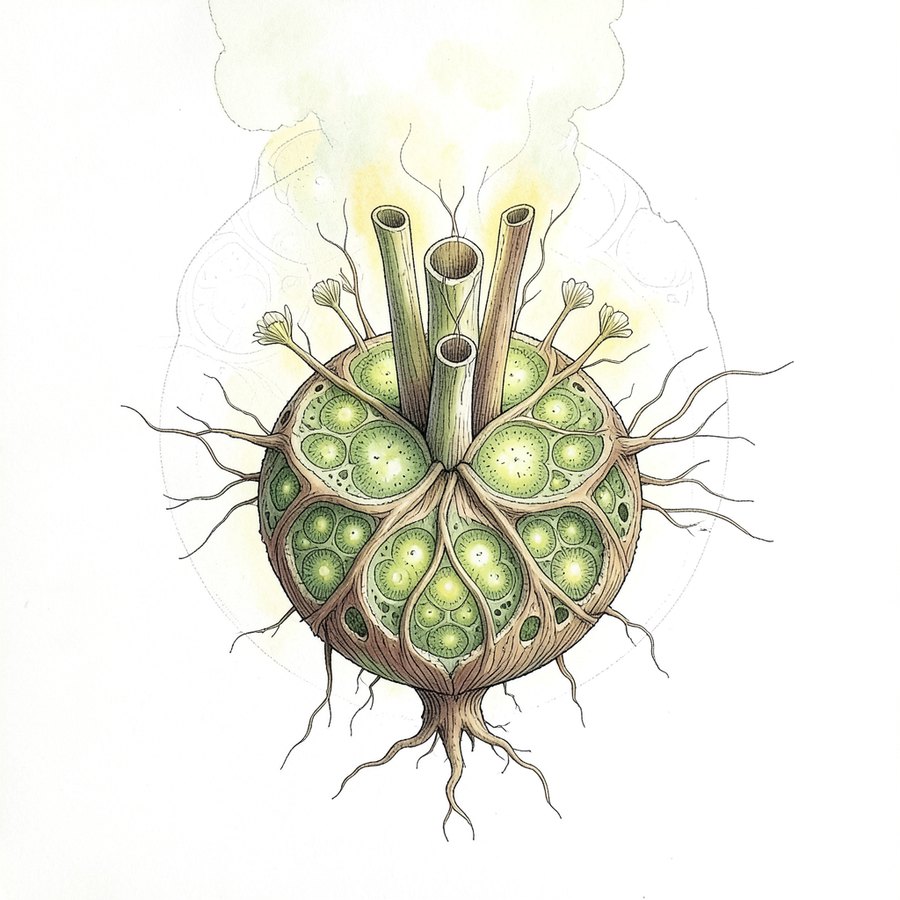
A body lives only by taking in the air around it and giving it back in a rhythm it keeps without thinking, so breath is the place where inside and outside are exchanged.
To live is to keep giving back what you take.
behavior Swells and empties in a slow rhythm, and leaves a faint cloud of itself wherever it has been.
Whose air are you breathing now, and who will breathe yours?
I Dissection
Each organ answers one question about the idea. The framed one, its dispersal, is the dominant organ: the being's class, the one the idea could not lose and stay itself.
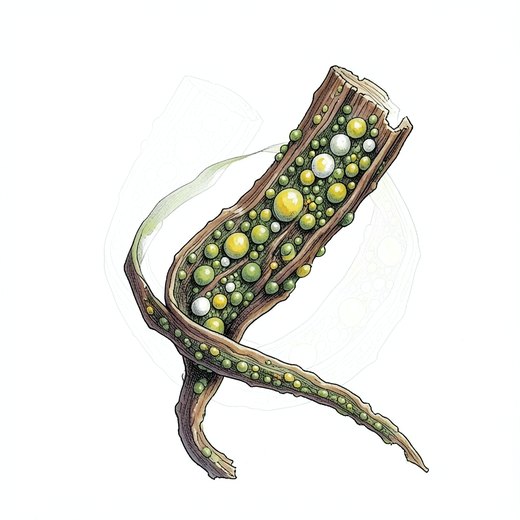
Fig. 1. Kernel
Tidal volume
Which premise, if it were false, would kill this idea?
A body lives only by taking in the air around it and giving it back, again and again, never pausing long enough to stop.2
drawn as: tidal volume · view: series
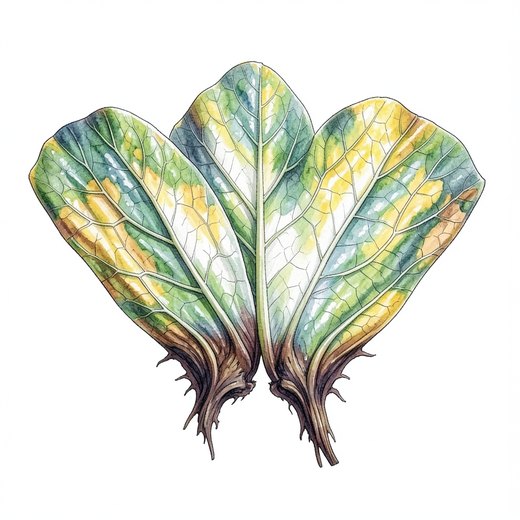
Fig. 2. Boundary
Alveoli
What sets it apart from what it is not, and how does it keep that distinction?
It keeps the inside of a body open to the outside through the thinnest of walls, where air and blood are only a few cells apart.2
drawn as: alveoli · view: pressed
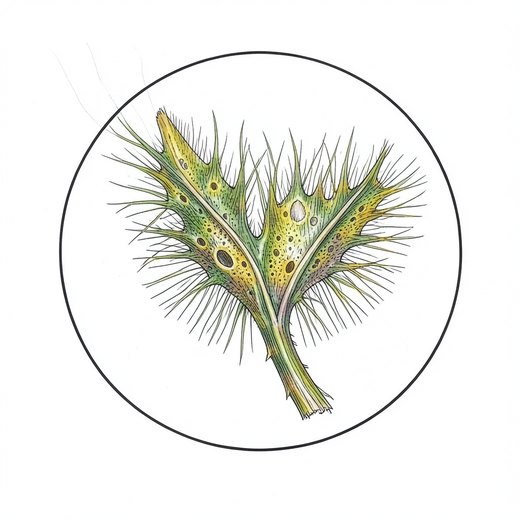
Fig. 3. Intake
Stomata
What must it feed on to work? What has to be present, noticed or supplied?
It feeds on air, and on the plants that give back what it spends.4
drawn as: stomata · view: microscope
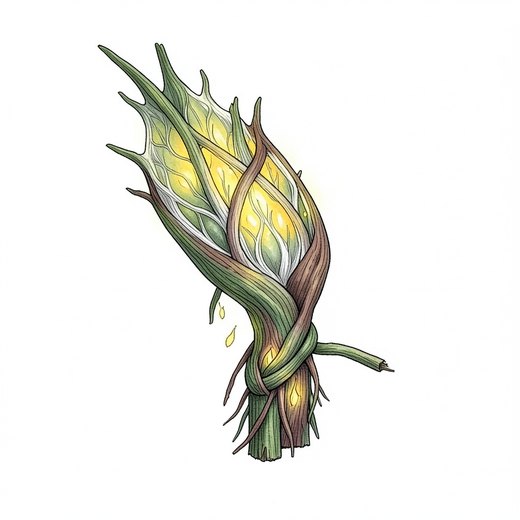
Fig. 4. Mechanism
Bellows
How does it turn what it takes in into what it gives out?
A small cluster of cells in the brainstem keeps the rhythm, and the chest fills and empties without being told.5
drawn as: bellows · view: transparent
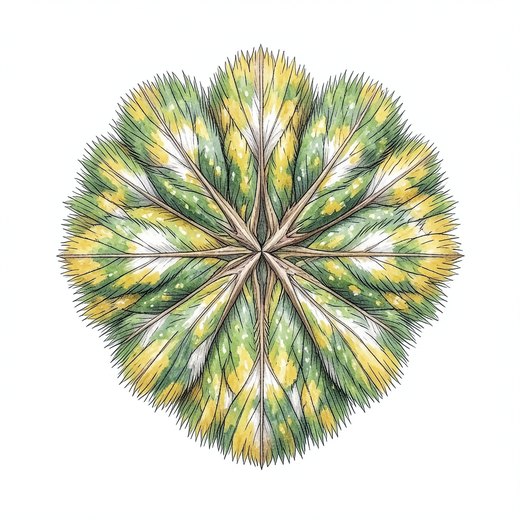
Fig. 5. Output
Long exhale
What does it make possible, visible or knowable?
It gives voice, song and sighs, and a pace that calms or quickens the whole body.3
drawn as: long exhale · view: magnified
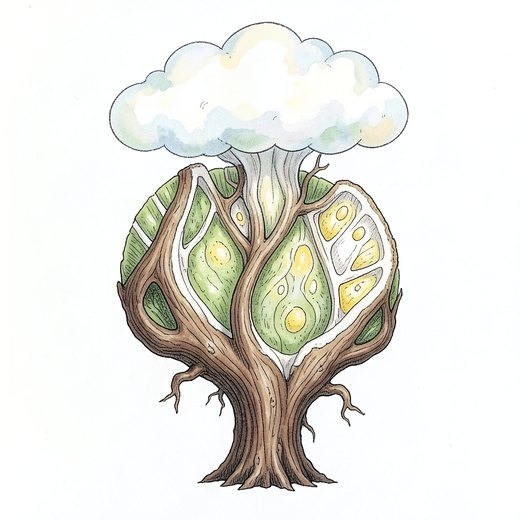
Fig. 6. Dispersal
Spirit
❦ dominant organWhat part of it travels into other minds, ideas and fields, and by what vector?
It leaves the body as the visible part of a life, a cloud on a cold morning, a spoken word, the breath once said to have been blown into clay to make it live.1
drawn as: spirit · view: cast
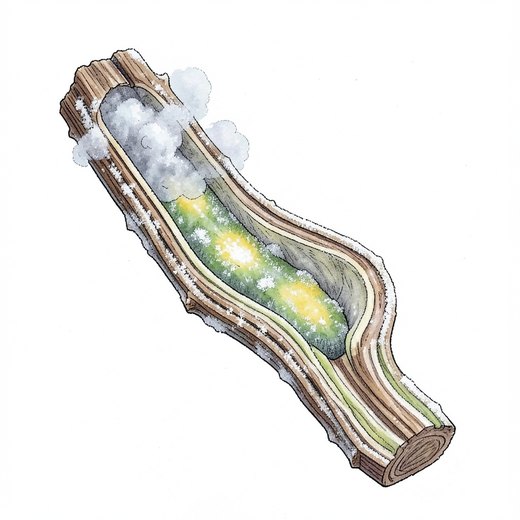
Fig. 7. Decay
Last gasp
What can it not digest, where does it fail, and what does it leave behind for others?
It cannot be stored; held, it fails within minutes, and the last breath is the oldest sign of death.2
drawn as: last gasp · view: cross section
II Meaning associations
descent membership food web resemblance or friction
Lineage
A founder, dissected by hand.
Offspring
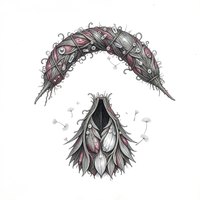
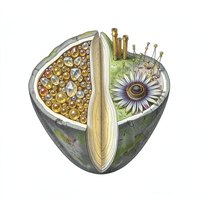
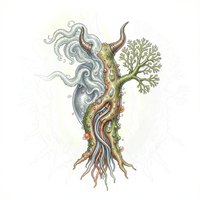
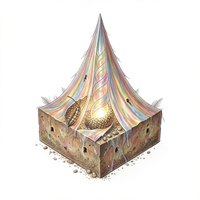
Food web
- feeds the mechanism of Fear → its mechanism
Fear floods the body and quickens the breath; the rhythm Breath keeps without thinking is the first thing fear changes. - feeds its output → the intake of Fear
Breath gives a pace that calms or quickens the whole body; Fear feeds on signs of threat, and a fast shallow breath is read as one. - friction its kernel rubs against the decay of Fear
Breath cannot stop; Fear held too long hardens into dread. The one keeps going, the other gets stuck. - pollinated the dispersal of Music → its kernel
Music travels by ear, voice to voice; Breath's premise is a rhythm kept without thinking, and a sung phrase sets exactly when the singer must breathe. The vector can carry the premise. - feeds its output → the intake of Music
Breath gives voice and song; Music feeds on vibration, and the voice is its first instrument. - homology its mechanism resembles the mechanism of Music
Both are rhythms that bodies fall into, the breathing cycle and the musical pulse. - friction its decay rubs against the decay of Music
Breath cannot be stored or held; Music, grown too familiar, wears into background. One fails by stopping, the other by repeating. - feeds its output → the intake of Qualia
Breath gives a pace that calms the whole body; a steady breath is the oldest instrument for holding attention on experience. - friction its mechanism rubs against the decay of Qualia
Qualia cannot be measured or shared; Breath is measured easily, a rhythm in the brainstem. One is all inside, the other readable from outside.
Kin
same kind in Roget Amber, Chiaroscuro, Chimera, Entelechy, Iridescence, Music, Silence, Tinnitus, Vertigo, Shared Breath
same kind in Wilkins Awakening, Shared Breath
same kind in WordNet Awakening, Entelechy, Entropy, Erosion, Fire, Metamorphosis, Petrification, Rushmaker, Shared Breath, Self-Ending Order, Tongue Horizon, Witnessed Relief, Gazeroot (second reading), Commemorative Revision, The Swing Door
same kind in Llull Entelechy, Metamorphosis, Spring
same phylum Ash, Echolalia, Lullaby, Metamorphosis, Resonance, Commemorative Revision, The Swing Door, Tide of Days, Simultaneous Remembering, Poetry
same dominant organ Ash, Miracle, Pointillism, River, Sand, Wind, Witnessed Relief
Genome
- rhythm also in The Swing Door, Music, Poetry, Shared Breath, Syllable, Trance
- exchange
- air
- voice also in Echolalia, Lullaby, Poetry, Possession, Shared Breath
- life
III In the world
Echoes
- a cloud of breath on a cold morning
- a sigh
- the breath blown into clay
- a singer's held note
IV Record
How it was drawn
its draw 2, a point in the morphospace (laws §8), drawn by flux-2-klein-4b.safetensors.
| axis | value | |
|---|---|---|
| book | pathemata | |
| symmetry | radial 8 | |
| organization | solitary | |
| silhouette | vase | |
| scale | microscopic | |
| proportion | elongated latent | |
| growth | accretion | |
| articulation | sutured latent | |
| openness | hollow latent | |
| skeleton | woody latent | |
| locomotion | undulating latent | |
| pattern | rosettes latent | |
| coloration | nuptial latent | |
| substance | bark | |
| surface | perforated | |
| palette | meadow | |
| luminosity | inner glow | |
| transparency | opaque latent | |
| gesture | emits | |
| unity | fragment | |
| modality | unmarked latent | |
| causation | formal | |
| determinacy | dissolving latent | |
| fusion | carried | |
| anomaly | echoes | |
| graft | pipes | |
| technique | stipple | |
| viewpoint | above | |
| value | low key latent | |
| balance | cantilevered | |
| density | sparse latent | |
| rhythm | alternating latent | |
| saturation | vivid latent | |
| appendages | petals | |
| anchor (body) | a volvox, a hollow sphere of green cells with daughter spheres inside | |
| anchor (detail) | fine fungal threads wrapped around root tips |
Sources
- Genesis 2:7
- Aristotle, On Youth, Old Age, Life and Death, and Respiration (4th century BCE)
- Patañjali, Yoga Sutras 2.49 to 2.53, on pranayama, the regulation of breath
- Joseph Priestley, Observations on Different Kinds of Air (1772)
- Jeffrey C. Smith, Jack L. Feldman and others, Pre-Bötzinger Complex: A Brainstem Region That May Generate Respiratory Rhythm in Mammals (Science, 1991)
❦