a founder of the codex
Syllable
Sonopetala articulata·the Pulse Blossom
From Latin sonus, sound, Greek petalon, a leaf or petal, and Latin articulatus, jointed; a flower of jointed sound.
- Level
- Conceptorganism
- Phylum
- Part and wholeimage schema
- Class
- Kernelits nucleus
- Niche
- Producerraw experience
- Mode
- Habithow it keeps existing
- Stage
- Matureindividuated
- Status
- Living
- Habitat
- Body
Its kinds · Roget, 1852: Communication of Ideas · Wilkins, 1668: Discourse · WordNet, 1990: Communication · Llull, 1308: K · Instrumentative
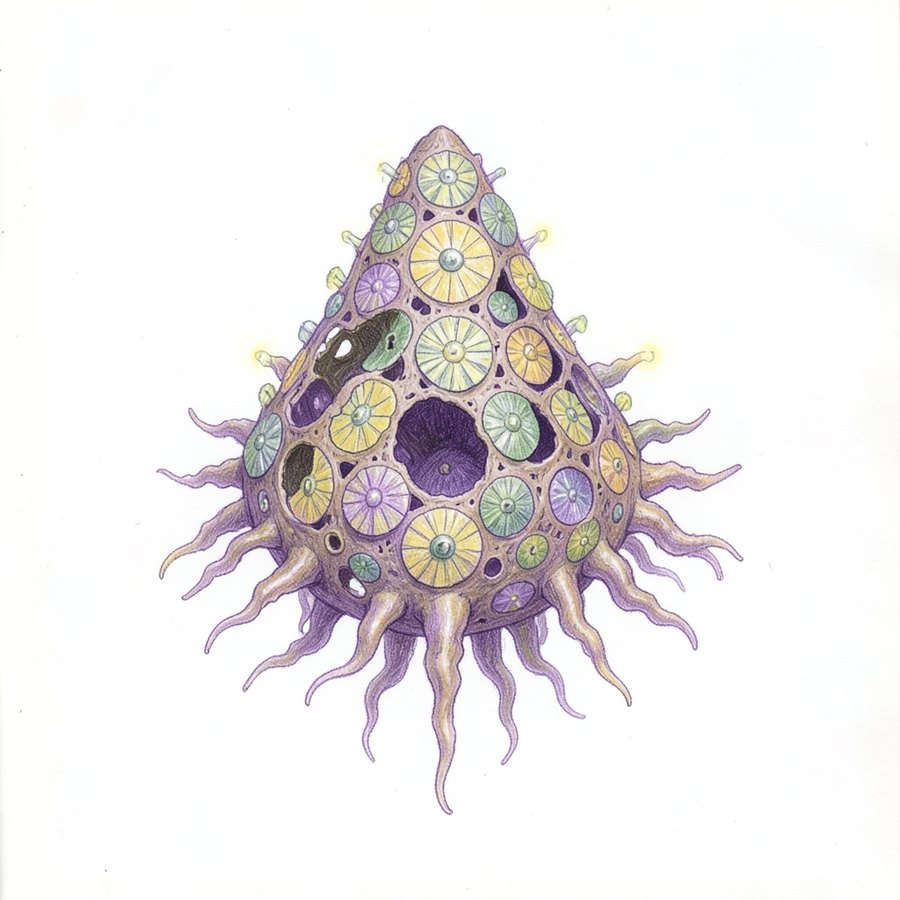
The smallest beat of speech is also its seed, since words, rhythm and rhyme all grow from how syllables combine.
Language is breath cut into beats.
behavior Opens and closes in a steady beat, and every time it opens a new facet of a slightly different shape is added.
What could a language with a single syllable still say?
I Dissection
Each organ answers one question about the idea. The framed one, its kernel, is the dominant organ: the being's class, the one the idea could not lose and stay itself.
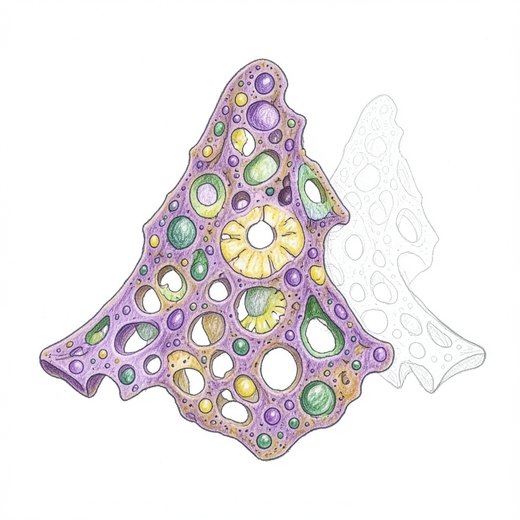
Fig. 1. Kernel
Nucleus
❦ dominant organWhich premise, if it were false, would kill this idea?
Speech comes in pulses, each built around a peak of sonority, usually a vowel, with quieter sounds at its edges.1, 2
drawn as: nucleus · view: exploded
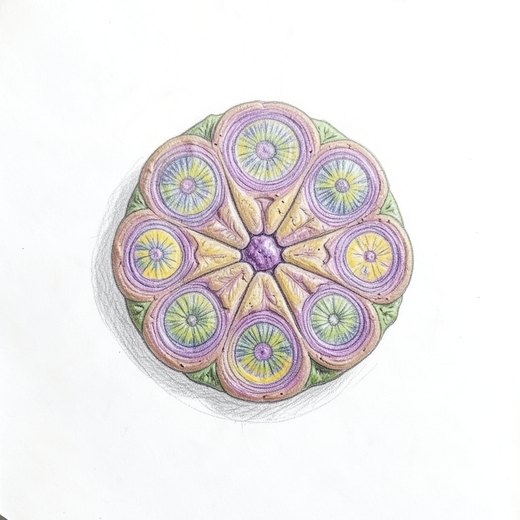
Fig. 2. Boundary
Sonority trough
What sets it apart from what it is not, and how does it keep that distinction?
It is bounded by dips in sonority; where loudness falls between two peaks, one syllable ends and the next begins.2
drawn as: sonority trough · view: at work
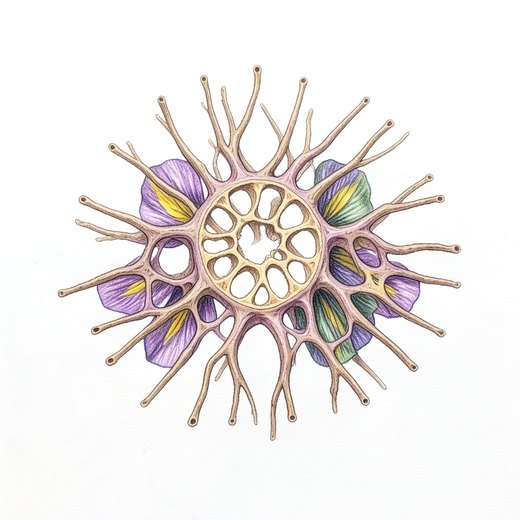
Fig. 3. Intake
Pulmonic airstream
What must it feed on to work? What has to be present, noticed or supplied?
It takes in breath, and the sounds its language allows, an inventory of consonants and vowels.1
drawn as: pulmonic airstream · view: pinned
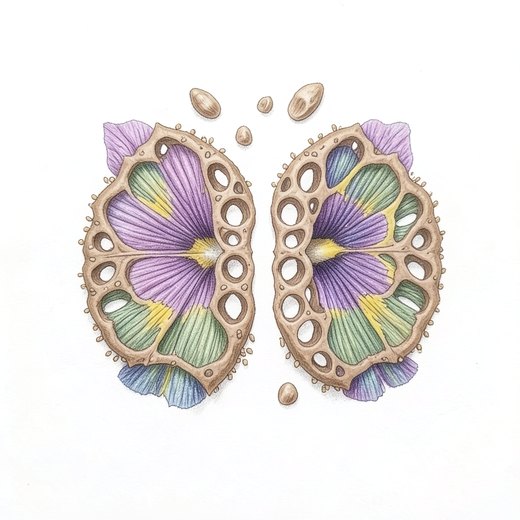
Fig. 4. Mechanism
Jaw cycle
How does it turn what it takes in into what it gives out?
Each opening and closing of the mouth around the vowel makes one beat, and the language's rules decide which sounds may gather before and after it.1, 2
drawn as: jaw cycle · view: pinned
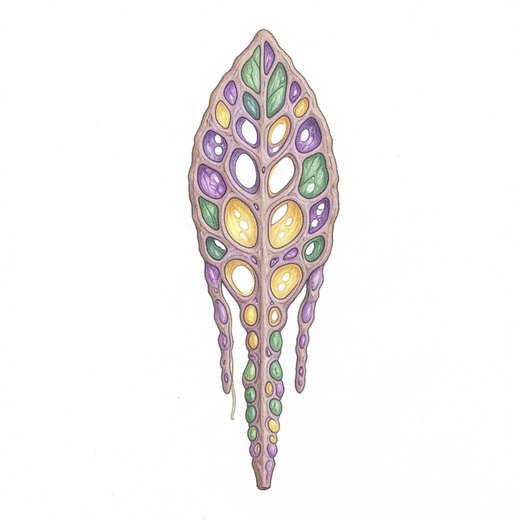
Fig. 5. Output
Metrical foot
What does it make possible, visible or knowable?
It gives the units of rhythm, stress and rhyme, and the pieces words are built from.1
drawn as: metrical foot · view: cross section
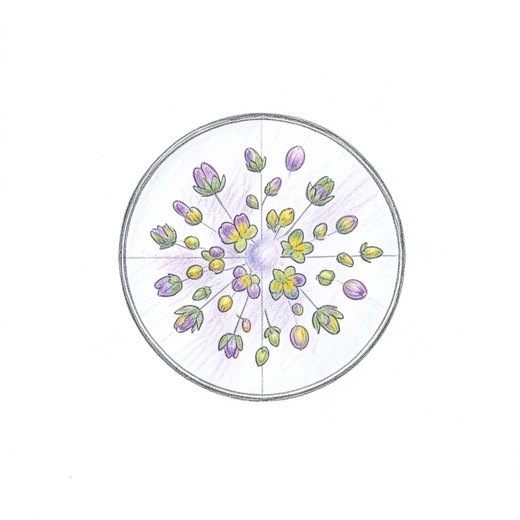
Fig. 6. Dispersal
Rebus
What part of it travels into other minds, ideas and fields, and by what vector?
It spreads by combination, a few hundred syllables recombining into all the words of a language, and syllabaries carried writing from one people to another.3
drawn as: rebus · view: microscope
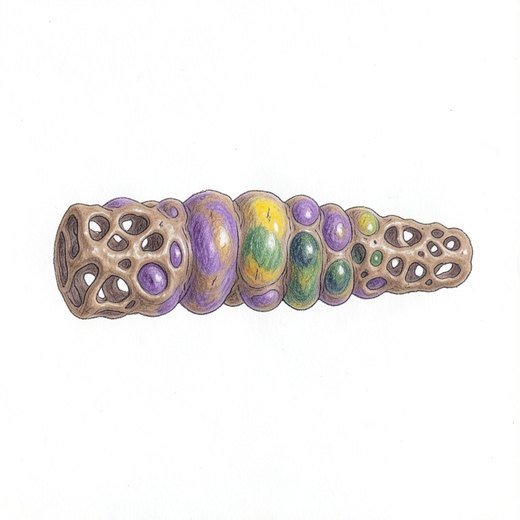
Fig. 7. Decay
Phonetic erosion
What can it not digest, where does it fail, and what does it leave behind for others?
Fast speech wears syllables down and merges them, and some languages stack consonants so thickly that the beat is hard to count.1
drawn as: phonetic erosion · view: series
II Meaning associations
descent membership food web resemblance or friction
Lineage
A founder, dissected by hand.
Offspring
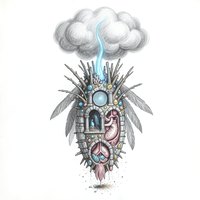
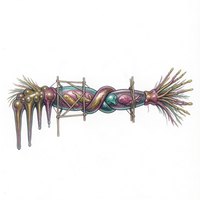
Food web
Kin
same kind in Roget Echolalia, Glossolalia, Pointillism, Symbol, Babelhum, Poetry
same kind in Wilkins Echolalia, Glossolalia, Prophecy, Symbol, Babelhum, Tongue Horizon, Poetry
same kind in WordNet Chiaroscuro, Echolalia, Glossolalia, Lullaby, Music, Prophecy, Symbol, Babelhum, Poetry
same kind in Llull Chiaroscuro, Faith, Geomancy, Innocence, Lullaby, Music, Patience, Pointillism, Ritual, Symbol, Foresilence, Tide of Days, Subtractive Phenomenology
same phylum Chimera, Emergence, Petrification, Pointillism, Babelhum, Subtractive Phenomenology
same dominant organ Archipelago, Entanglement, Entelechy, Eternity, Geomancy, Qualia, Salt, Symmetry, Vertigo, Volition, Weightlessness, Knowing Trust, Hesychology
Genome
- pulse
- sonority
- rhythm also in Breath, The Swing Door, Music, Poetry, Shared Breath, Trance
- unit
- combination
III In the world
Echoes
- a baby babbling ba-ba-ba
- Japanese kana, a syllabary
- the Cherokee syllabary devised by Sequoyah
- counting syllables in a haiku
IV Record
How it was drawn
its draw 4, a point in the morphospace (laws §8), drawn by flux-2-klein-4b.safetensors.
| axis | value | |
|---|---|---|
| book | nidi | |
| symmetry | fractal | |
| organization | solitary | |
| silhouette | cage | |
| scale | hand | |
| proportion | even latent | |
| growth | grafted | |
| articulation | telescoping latent | |
| openness | lattice latent | |
| skeleton | test latent | |
| locomotion | rolling latent | |
| pattern | reticulate latent | |
| coloration | plain latent | |
| substance | mud | |
| surface | perforated | |
| palette | iris | |
| luminosity | points | |
| transparency | opaque latent | |
| gesture | dissolves | |
| unity | composite | |
| modality | necessary | |
| causation | formal | |
| determinacy | crisp latent | |
| fusion | built of | |
| anomaly | none | |
| graft | keyholes | |
| technique | crayon | |
| viewpoint | cutaway | |
| value | flat latent | |
| balance | leaning latent | |
| density | graded detail latent | |
| rhythm | regular latent | |
| saturation | vivid latent | |
| appendages | tentacles | |
| anchor (body) | a pyrosome, a hollow glowing tube made of thousands of small bodies | |
| anchor (detail) | a pyrite sun, a flat disc of radiating crystal |
Sources
- Peter Ladefoged, A Course in Phonetics (1975)
- The sonority sequencing principle, after Eduard Sievers and Otto Jespersen
- Peter Daniels and William Bright, The World's Writing Systems (1996)
❦