a founder of the codex
Frost
Pruinaria plumata·the Night Feather
From Latin pruina, hoarfrost, and plumata, feathered, the frost that grows its crystals into feathers overnight.
- Level
- Conceptorganism
- Phylum
- Scaleimage schema
- Class
- Boundaryits dewdrop
- Niche
- Parasitethe mechanism of a host idea
- Mode
- Metamorphosishow it keeps existing
- Stage
- Matureindividuated
- Status
- Living
- Habitat
- Forest
Its kinds · Roget, 1852: Inorganic Matter · Wilkins, 1668: Element · WordNet, 1990: Phenomenon · Llull, 1308: I · Elementative
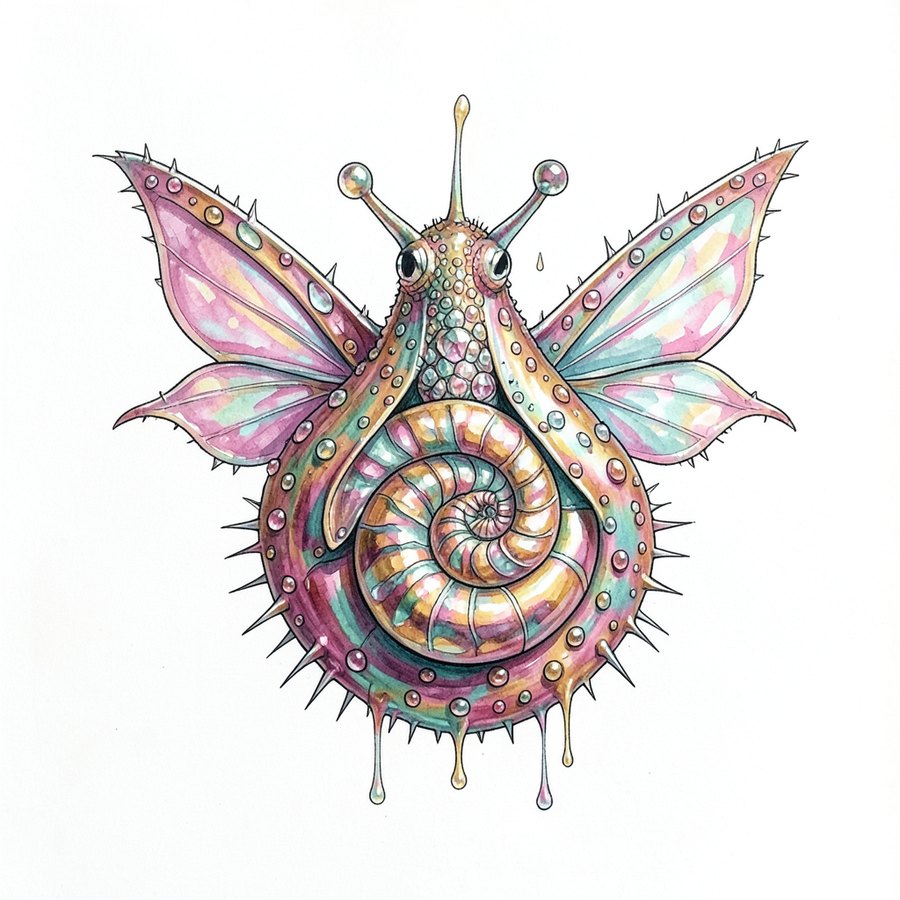
Frost is vapour that freezes straight onto ground colder than the air on still, clear nights, growing feathered crystals that show where the cold lies and vanish at sunrise.
On a still, cold night the air's own moisture sets into form wherever the ground is coldest.
behavior It appears overnight without a sound, feathers whatever lies coldest, and is gone at the first touch of sun.
What would settle on you if you stayed perfectly still through one cold night?
I Dissection
Each organ answers one question about the idea. The framed one, its boundary, is the dominant organ: the being's class, the one the idea could not lose and stay itself.
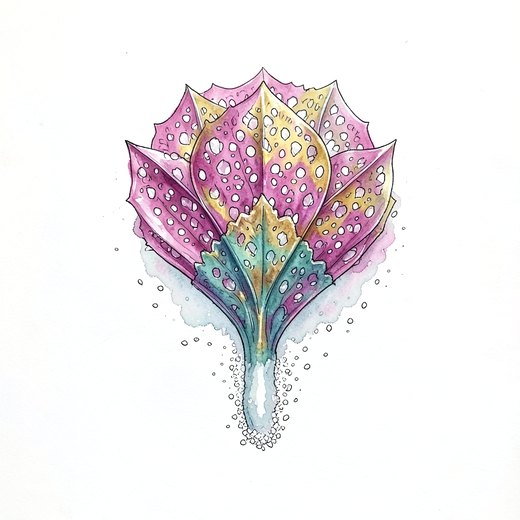
Fig. 1. Kernel
Deposition
Which premise, if it were false, would kill this idea?
Frost is water vapour that freezes straight onto a surface below freezing, passing from vapour to ice and skipping the liquid between.1
drawn as: deposition · view: series
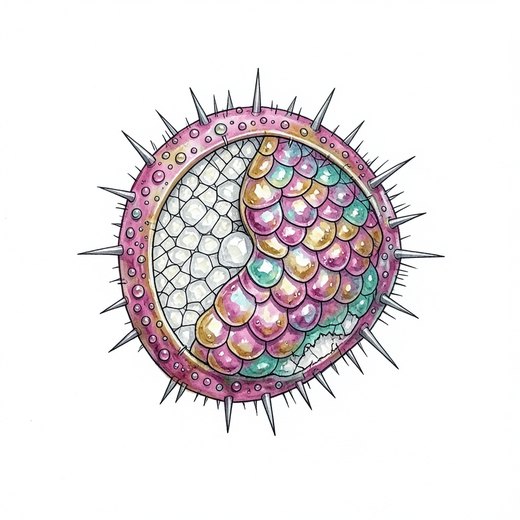
Fig. 2. Boundary
Dewdrop
❦ dominant organWhat sets it apart from what it is not, and how does it keep that distinction?
It is set apart from dew by a few degrees. On the same still night, vapour beads as dew on surfaces above freezing and grows as ice crystals on surfaces below it.3
drawn as: dewdrop · view: in situ
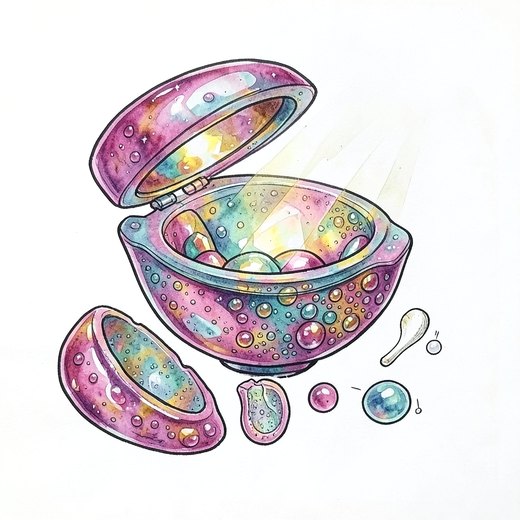
Fig. 3. Intake
Cold air pool
What must it feed on to work? What has to be present, noticed or supplied?
It feeds on clear, windless nights, when the ground loses its heat to the open sky and the coldest air slides downhill to lie still in hollows.3
drawn as: cold air pool · view: pinned
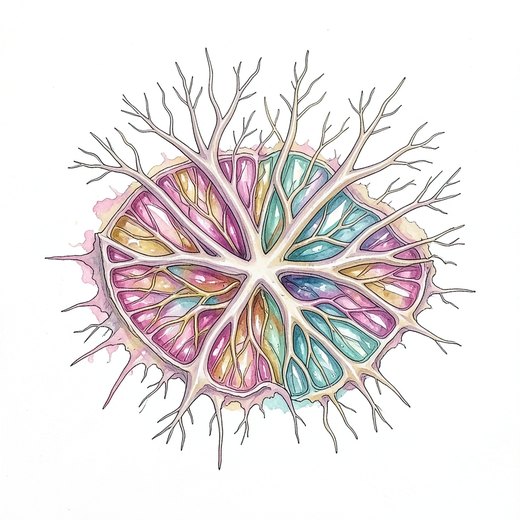
Fig. 4. Mechanism
Dendrite
How does it turn what it takes in into what it gives out?
Vapour reaches the corners and tips of a growing crystal first, so ice builds fastest there and branches into needles, plates and feathers, their form set by the temperature and moisture of the air.1
drawn as: dendrite · view: cross section
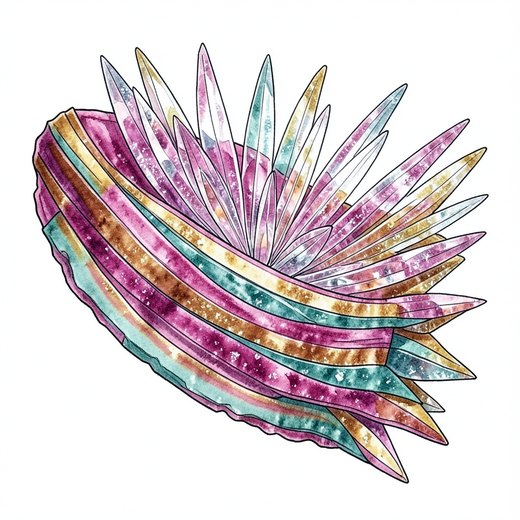
Fig. 5. Output
Ice ferns
What does it make possible, visible or knowable?
By dawn it whitens every blade and twig and grows branching fern patterns over cold glass, making the night's cold visible as a fringe of crystals.2
drawn as: ice ferns · view: magnified
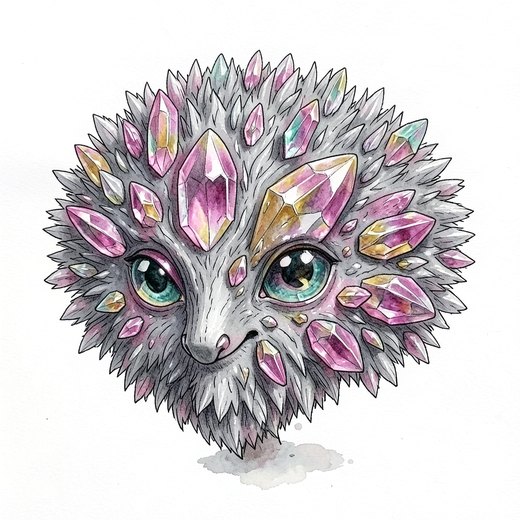
Fig. 6. Dispersal
Hoary head
What part of it travels into other minds, ideas and fields, and by what vector?
It travels as a figure of age, white frost and white hair sharing the old word hoar, and into poems as a silent maker that works by night, as in Coleridge's 'Frost at Midnight'.5
drawn as: hoary head · view: series
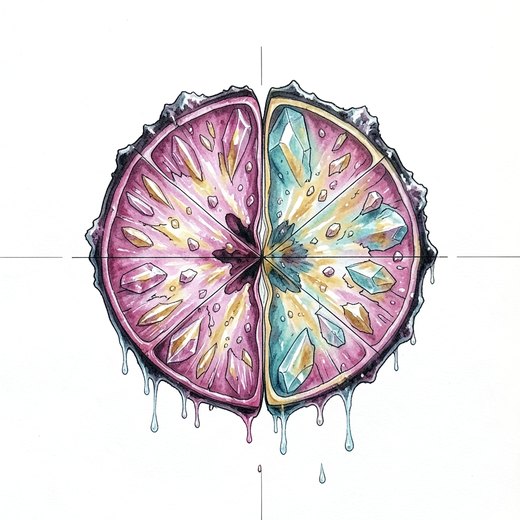
Fig. 7. Decay
Blackened dahlia
What can it not digest, where does it fail, and what does it leave behind for others?
Wind or cloud keeps it away and the first sun takes it within the hour, and on tender leaves its ice tears the cells and leaves dahlias blackened by noon.4
drawn as: blackened dahlia · view: cross section
II Meaning associations
No relations recorded yet.
descent membership food web resemblance or friction
Lineage
A founder, dissected by hand.
Kin
same kind in Roget Archipelago, Ash, Clay, Cloud, Diamond, Erosion, Fire, Lake, Rain, River, Salt, Sand, Storm, Wind
same kind in Wilkins Cloud, Fire, Lake, Rain, River, Storm, Wind
same kind in WordNet Emergence, Iridescence, Placebo, Rain, Reflection, Resonance, Resonance (second reading), Storm, Wind
same kind in Llull Amber, Archipelago, Ash, Clay, Cloud, Diamond, Emergence, Entanglement, Entropy, Erosion, Fire, Iridescence, Lake, Petrification, Rain, Reflection, Resonance, Resonance (second reading), River, Salt, Sand, Storm, Weightlessness, Wind, Winter, Self-Ending Order
same phylum Entropy, Iridescence, Patience, Sand, Silence, Trance, Hesychology
same dominant organ Amber, Aura, Cloud, Diamond, Equinox, Possession, Reflection, Solitude, Threshold, Tongue Horizon, The Shared Cell
Genome
III In the world
Echoes
- fern patterns on a cold windowpane
- a white lawn at dawn
- a frost hollow on a valley floor
- dahlias blackened by the first frost
IV Record
How it was drawn
its draw 4, a point in the morphospace (laws §8), drawn by flux-2-klein-4b.safetensors.
| axis | value | |
|---|---|---|
| book | humores | |
| symmetry | bilateral | |
| organization | solitary | |
| silhouette | sac | |
| scale | hand | |
| proportion | swollen | |
| growth | swelling | |
| articulation | imbricate latent | |
| openness | solid latent | |
| skeleton | test latent | |
| locomotion | jetting latent | |
| pattern | rosettes latent | |
| coloration | disruptive latent | |
| substance | crystal | |
| surface | beaded | |
| palette | bismuth | |
| luminosity | sheen | |
| transparency | layered | |
| gesture | emits | |
| unity | fragment latent | |
| modality | possible latent | |
| causation | formal latent | |
| determinacy | dissolving | |
| fusion | built of | |
| anomaly | none | |
| graft | wax | |
| technique | watercolour | |
| viewpoint | below | |
| value | unmarked latent | |
| balance | unmarked latent | |
| density | intricate latent | |
| rhythm | unmarked latent | |
| saturation | unmarked latent | |
| appendages | valves, tendrils | |
| anchor (body) | a sea angel, a translucent sea snail swimming on two wing-like lobes | |
| anchor (detail) | a nautilus shell cut open to show its spiral chambers |
Sources
- Ukichiro Nakaya, Snow Crystals: Natural and Artificial (1954)
- W. A. Bentley and W. J. Humphreys, Snow Crystals (1931)
- Rudolf Geiger, Das Klima der bodennahen Luftschicht (1927), translated as The Climate Near the Ground
- Akira Sakai and Walter Larcher, Frost Survival of Plants (1987)
- Samuel Taylor Coleridge, Frost at Midnight (1798)
❦