a founder of the codex
Emergence
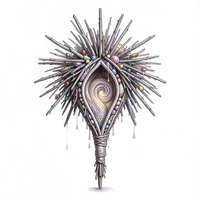
Holobotrys oriens·the Rising Cluster
From Greek holos, whole, and botrys, a cluster of grapes, and Latin oriens, rising; a cluster from which a whole rises.
- Level
- Conceptorganism
- Phylum
- Part and wholeimage schema
- Class
- Outputits levels of organization
- Niche
- Producerraw experience
- Mode
- Organizationhow it keeps existing
- Stage
- Juvenileindividuating
- Status
- Living
- Habitat
- Forest
Its kinds · Roget, 1852: Quantity · Wilkins, 1668: Transcendental Mixed · WordNet, 1990: Phenomenon · Llull, 1308: I · Elementative
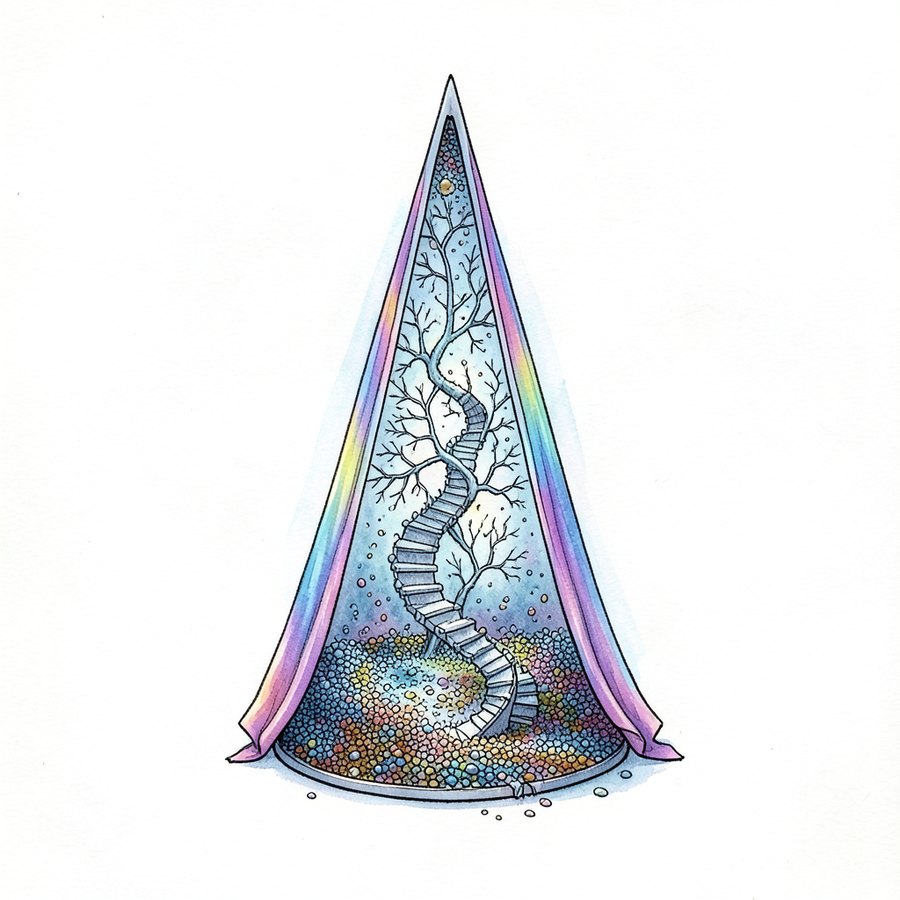
When many parts interact, the whole can do what no part can, and that new behaviour needs its own description.
More is different.
behavior Begins as a scatter of tiny seeds that drift toward one another, and blooms only when enough of them have touched.
What could a group of people do together that none of them could even imagine alone?
I Dissection
Each organ answers one question about the idea. The framed one, its output, is the dominant organ: the being's class, the one the idea could not lose and stay itself.
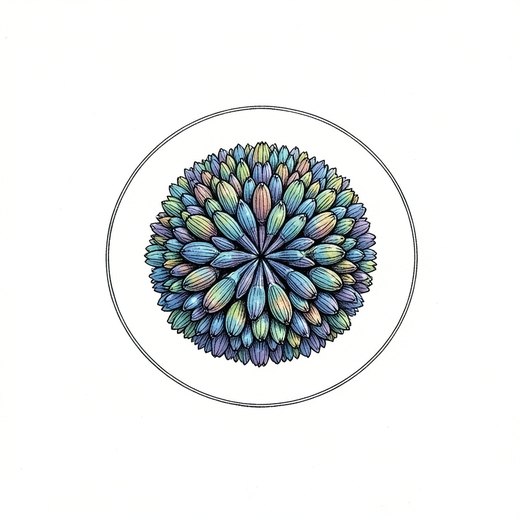
Fig. 1. Kernel
Superorganism
Which premise, if it were false, would kill this idea?
Wholes can have properties that none of their parts has, arising from how the parts interact rather than from any part alone.1, 2
drawn as: superorganism · view: microscope
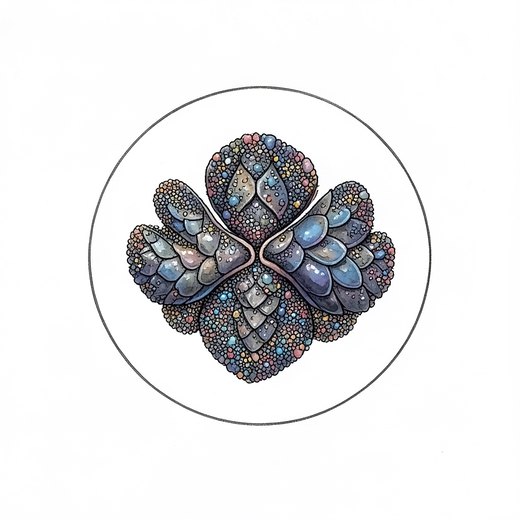
Fig. 2. Boundary
Percolation threshold
What sets it apart from what it is not, and how does it keep that distinction?
It is set apart from mere aggregation; a heap of sand has no property its grains lack, while an ant colony does.1
drawn as: percolation threshold · view: microscope
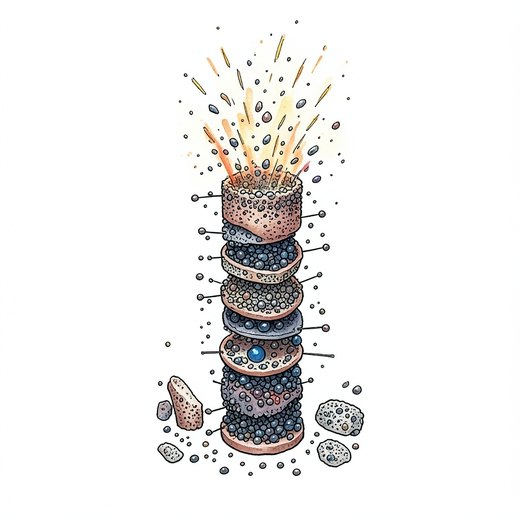
Fig. 3. Intake
Nearest neighbours
What must it feed on to work? What has to be present, noticed or supplied?
It needs many parts, local interactions between neighbours, and often a flow of energy that keeps them from settling.4
drawn as: nearest neighbours · view: pinned
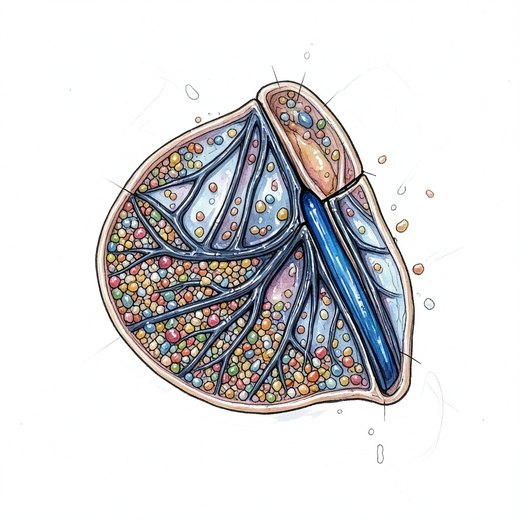
Fig. 4. Mechanism
Flocking rules
How does it turn what it takes in into what it gives out?
Simple local rules repeated among many parts add up to patterns no part encodes, as in flocks, convection cells and markets.2, 3
drawn as: flocking rules · view: transparent
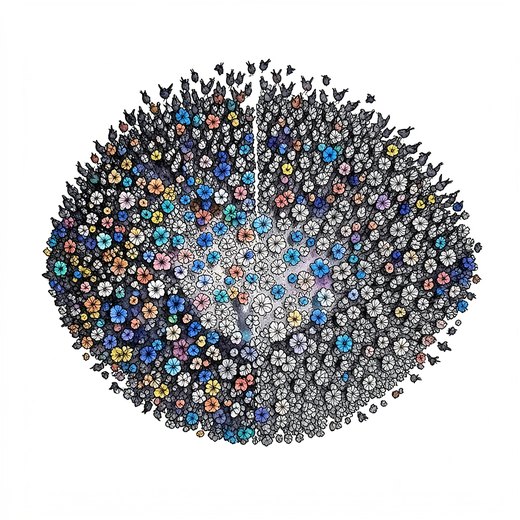
Fig. 5. Output
Levels of organization
❦ dominant organWhat does it make possible, visible or knowable?
It gives new levels of organization with their own laws, so that chemistry is more than physics and a mind more than neurons.1
drawn as: levels of organization · view: magnified
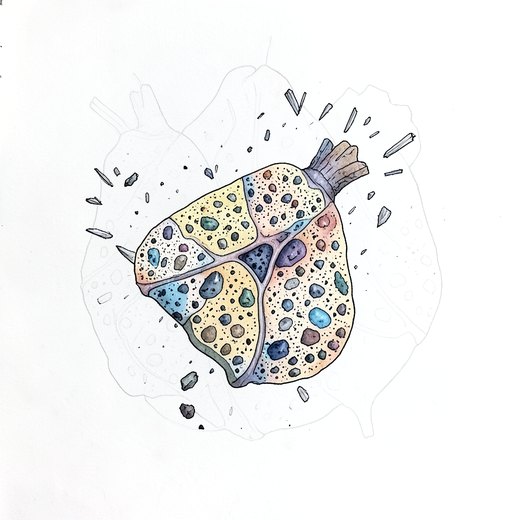
Fig. 6. Dispersal
Murmuration
What part of it travels into other minds, ideas and fields, and by what vector?
It travels as the saying that the whole is more than the sum of its parts, and as the image of the starling murmuration.1
drawn as: murmuration · view: series
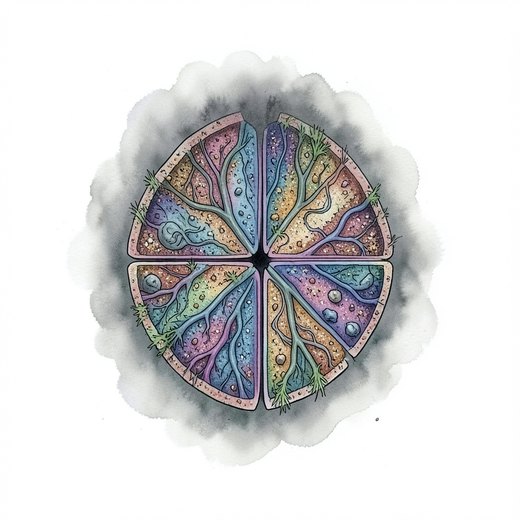
Fig. 7. Decay
Black box
What can it not digest, where does it fail, and what does it leave behind for others?
It can be used to name a mystery instead of explaining it, and it cannot say in advance which wholes will appear.5
drawn as: black box · view: cross section
II Meaning associations
descent membership food web resemblance or friction
Lineage
A founder, dissected by hand.
Offspring
Food web
- succeeds the decay of Entropy → its intake
Entropy cannot say why order arises locally, in life, crystals and storms. Emergence feeds on exactly that, many parts kept from settling by a flow of energy. Emergence lives on Entropy's failure, as both founders' notes predicted. - homology its intake resembles the boundary of Entropy
Entropy holds only in a closed system; open it to a flow of energy and local order can grow. Emergence needs that flow. - homology its mechanism resembles the mechanism of Entropy
Both are many parts exchanging, at random or by local rules. One drifts toward the probable, the other bends into a current. - friction its dispersal rubs against the dispersal of Entropy
Their images are opposites; the melting ice and the shuffled deck against the starling murmuration. Their kernels point the same way, order falling against order rising.
Kin
same kind in Wilkins Entanglement, Entropy, Symmetry, Self-Ending Order
same kind in WordNet Frost, Iridescence, Placebo, Rain, Reflection, Resonance, Resonance (second reading), Storm, Wind
same kind in Llull Amber, Archipelago, Ash, Clay, Cloud, Diamond, Entanglement, Entropy, Erosion, Fire, Frost, Iridescence, Lake, Petrification, Rain, Reflection, Resonance, Resonance (second reading), River, Salt, Sand, Storm, Weightlessness, Wind, Winter, Self-Ending Order
same phylum Chimera, Petrification, Pointillism, Syllable, Babelhum, Subtractive Phenomenology
same dominant organ Apophenia, Awakening, Chiaroscuro, Echolalia, Erosion, Glossolalia, Iridescence, Mimesis, Nostalgia, Placebo, Rain, Spring, Babelhum, Afterlistening, Tide of Days
Genome
- whole
- interaction
- self-organization also in Self-Ending Order
- level
- novelty
III In the world
Echoes
- a starling murmuration
- a termite mound built without a plan
- a traffic jam that forms with no accident
- a mind made of neurons
IV Record
How it was drawn
its draw 3, a point in the morphospace (laws §8), drawn by flux-2-klein-4b.safetensors.
| axis | value | |
|---|---|---|
| book | volvellae | |
| symmetry | fractal | |
| organization | chained | |
| silhouette | spire | |
| scale | microscopic | |
| proportion | tapering | |
| growth | swelling | |
| articulation | jointed | |
| openness | spongy latent | |
| skeleton | spicules latent | |
| locomotion | burrowing latent | |
| pattern | plain latent | |
| coloration | cryptic latent | |
| substance | sand | |
| surface | frosted | |
| palette | ink | |
| luminosity | inner glow | |
| transparency | layered latent | |
| gesture | pulses | |
| unity | aggregate latent | |
| modality | unmarked latent | |
| causation | formal | |
| determinacy | unmarked latent | |
| fusion | nested | |
| anomaly | larger inside | |
| graft | stair | |
| technique | watercolour | |
| viewpoint | below | |
| value | unmarked latent | |
| balance | grounded latent | |
| density | sparse latent | |
| rhythm | alternating latent | |
| saturation | accent latent | |
| appendages | cilia | |
| anchor (body) | an aurora, hanging curtains of coloured light | |
| anchor (detail) | a slime mold spreading as a veined network across a surface |
Sources
- Philip W. Anderson, More Is Different (Science, 1972)
- John Holland, Emergence: From Chaos to Order (1998)
- Craig Reynolds, Flocks, herds and schools: a distributed behavioral model (1987)
- Ilya Prigogine and Isabelle Stengers, Order out of Chaos (1984)
- Jaegwon Kim, Making Sense of Emergence (Philosophical Studies, 1999)
❦