a founder of the codex
Pointillism
Punctopsia miscens·the Distant Speckle
From Latin punctum, a dot, and Greek opsis, sight, and Latin miscens, mixing, a sight made of dots that the eye mixes.
- Level
- Conceptorganism
- Phylum
- Part and wholeimage schema
- Class
- Dispersalits halftone screen
- Niche
- Consumerother ideas
- Mode
- Techniquehow it keeps existing
- Stage
- Matureindividuated
- Status
- Living
- Habitat
- Classroom
Its kinds · Roget, 1852: Communication of Ideas · Wilkins, 1668: Operation · WordNet, 1990: Act · Llull, 1308: K · Instrumentative
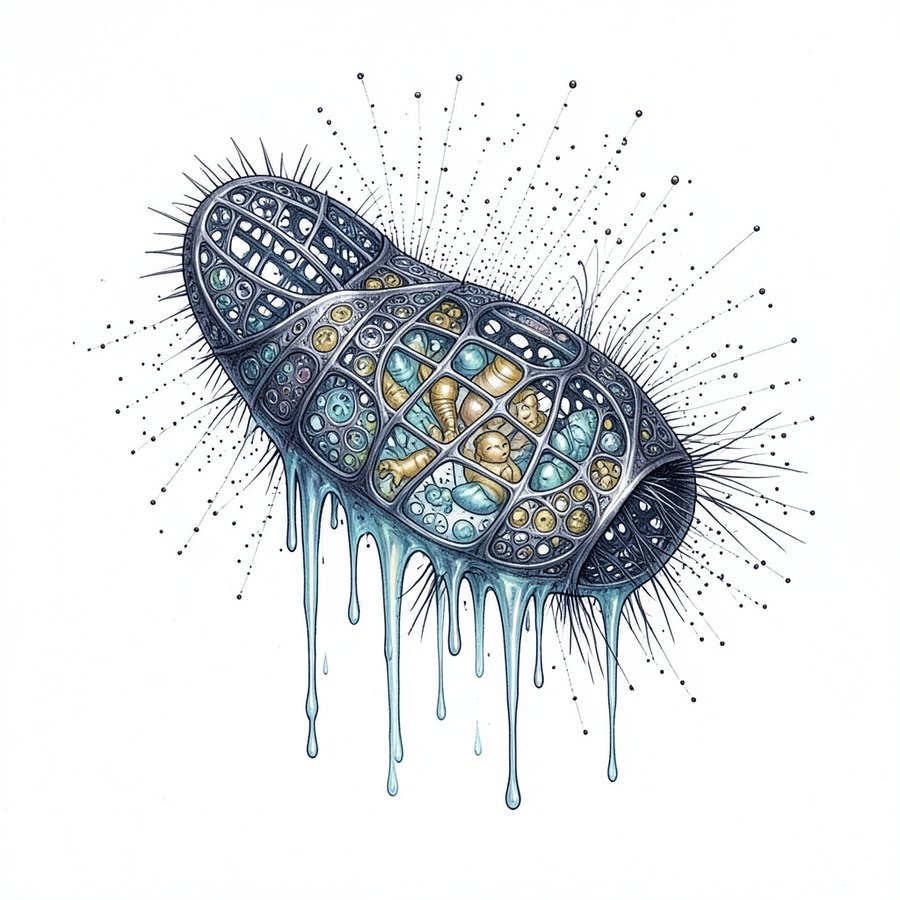
Pointillism builds an image from separate dots of pure colour that the eye fuses at a distance, so the picture is finished in the viewer's eye.
Separate points of pure colour become one image only for an eye standing far enough away to mix them.
behavior It looks like a scatter of specks up close and gathers into a single shimmering scene as you step back.
From how far away do the scattered parts of your days make one picture?
I Dissection
Each organ answers one question about the idea. The framed one, its dispersal, is the dominant organ: the being's class, the one the idea could not lose and stay itself.
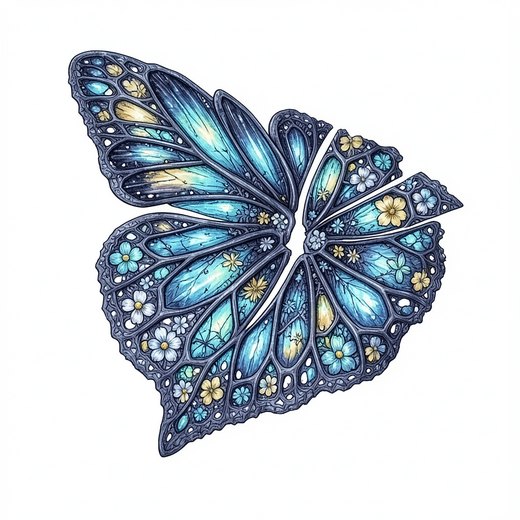
Fig. 1. Kernel
Optical mixture
Which premise, if it were false, would kill this idea?
Colours set side by side in dots too small to tell apart are mixed by the eye into one tone. Distance does the mixing that a brush once did on the palette.2, 1
drawn as: optical mixture · view: exploded
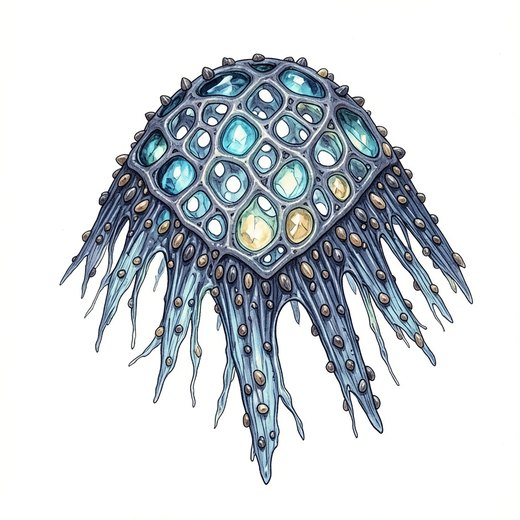
Fig. 2. Boundary
Painted border
What sets it apart from what it is not, and how does it keep that distinction?
It keeps every touch one pure hue, laid beside the next and unmixed on the palette. Seurat dotted a border around his canvases to hold the picture apart from the room.4, 3
drawn as: painted border · view: magnified
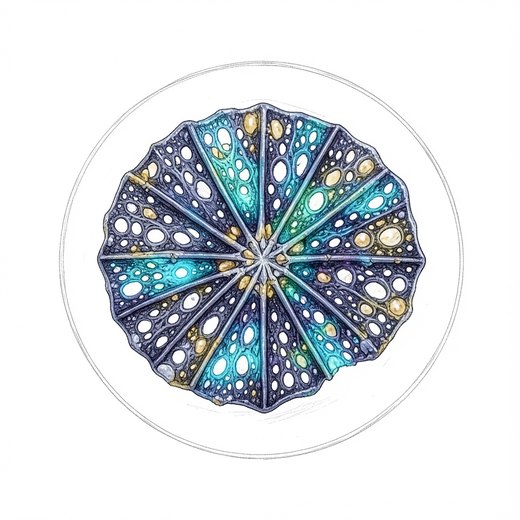
Fig. 3. Intake
Chromatic circle
What must it feed on to work? What has to be present, noticed or supplied?
It feeds on the science of colour, the laws of contrast set down by Chevreul and the measures of light and hue made by Rood.1, 2
drawn as: chromatic circle · view: microscope
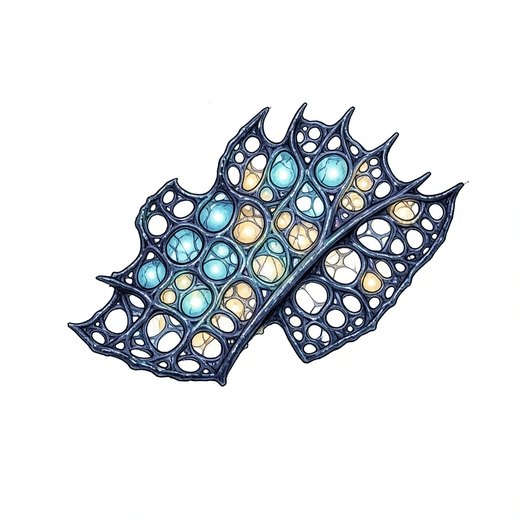
Fig. 4. Mechanism
Retinal mosaic
How does it turn what it takes in into what it gives out?
From far enough away each dot falls below what the eye can resolve, and neighbouring dots blur together on the retina into one mixed light.2
drawn as: retinal mosaic · view: exploded
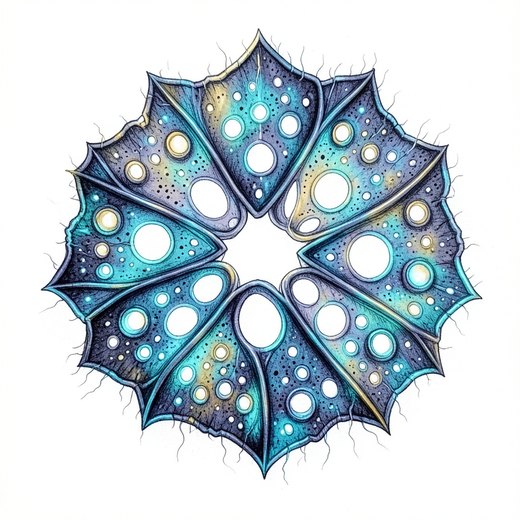
Fig. 5. Output
Irradiation
What does it make possible, visible or knowable?
It makes forms glow at their edges. Each shape is ringed by a seam of lighter or darker dots, set by the law of contrast, so figures stand in a trembling light.3, 1
drawn as: irradiation · view: at work
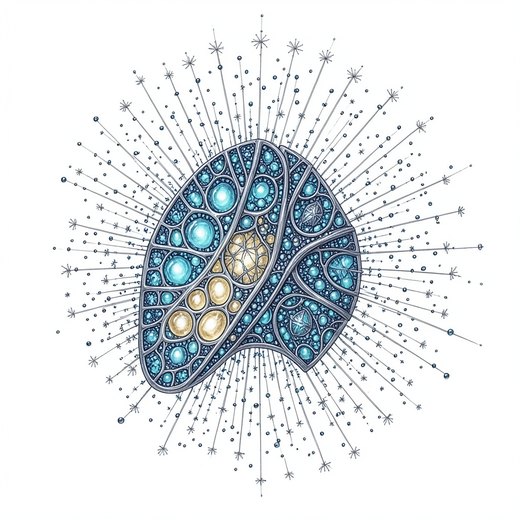
Fig. 6. Dispersal
Halftone screen
❦ dominant organWhat part of it travels into other minds, ideas and fields, and by what vector?
It travels into print and screens. The halftone dots of the printed photograph and the pixels of every display build images the same way, from separate points the eye fuses.5
drawn as: halftone screen · view: cast
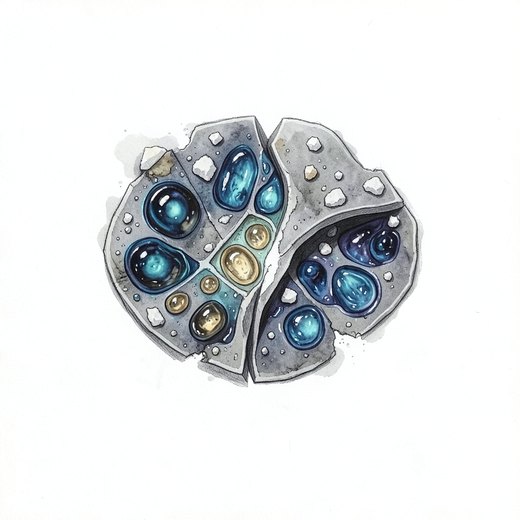
Fig. 7. Decay
Neutral grey
What can it not digest, where does it fail, and what does it leave behind for others?
Seen from too far, complementary dots fuse into grey, and close up the picture falls back into dots. Its painters soon widened the dots into broad square strokes.2, 4
drawn as: neutral grey · view: cross section
II Meaning associations
No relations recorded yet.
descent membership food web resemblance or friction
Lineage
A founder, dissected by hand.
Kin
same kind in Roget Echolalia, Glossolalia, Syllable, Symbol, Babelhum, Poetry
same kind in Wilkins Lullaby, Mimesis
same kind in WordNet Geomancy, Mimesis, Ritual, Knowing Trust
same kind in Llull Chiaroscuro, Faith, Geomancy, Innocence, Lullaby, Music, Patience, Ritual, Syllable, Symbol, Foresilence, Tide of Days, Subtractive Phenomenology
same phylum Chimera, Emergence, Petrification, Syllable, Babelhum, Subtractive Phenomenology
same dominant organ Ash, Breath, Miracle, River, Sand, Wind, Witnessed Relief
Genome
- dot
- distance also in Aura
- mixture
- contrast also in Chiaroscuro
- method
III In the world
Echoes
- Seurat's Sunday afternoon on the Grande Jatte
- the halftone dots of a newspaper photograph
- the pixels of a screen
- a school art lesson in painting with dots
IV Record
How it was drawn
its draw 1, a point in the morphospace (laws §8), drawn by flux-2-klein-4b.safetensors.
| axis | value | |
|---|---|---|
| book | artes | |
| symmetry | helical | |
| organization | solitary | |
| silhouette | cage | |
| scale | immense | |
| proportion | swollen latent | |
| growth | faceted | |
| articulation | jointed latent | |
| openness | lattice | |
| skeleton | spicules | |
| locomotion | gliding latent | |
| pattern | plain latent | |
| coloration | countershaded latent | |
| substance | silica glass | |
| surface | perforated | |
| palette | abyss | |
| luminosity | sheen | |
| transparency | opaque latent | |
| gesture | gathers | |
| unity | composite latent | |
| modality | necessary | |
| causation | formal latent | |
| determinacy | dissolving latent | |
| fusion | built of | |
| anomaly | one break | |
| graft | origami | |
| technique | silverpoint | |
| viewpoint | profile | |
| value | unmarked latent | |
| balance | grounded latent | |
| density | graded detail latent | |
| rhythm | regular latent | |
| saturation | muted latent | |
| appendages | plumes | |
| anchor (body) | stalactites, slow hanging columns of dripped stone | |
| anchor (detail) | a diatom, a glass shell in two halves perforated with ordered pores |
Sources
- Michel Eugène Chevreul, De la loi du contraste simultané des couleurs (1839)
- Ogden N. Rood, Modern Chromatics (1879)
- Georges Seurat, A Sunday on La Grande Jatte (1884-1886)
- Paul Signac, D'Eugène Delacroix au néo-impressionnisme (1899)
- William M. Ivins Jr., Prints and Visual Communication (1953)
❦