a founder of the codex
Diamond
Adamantaria pressa·the Pressed Light
From Greek adamas, unconquerable, the old name of the diamond, and Latin pressa, pressed, the unconquerable stone made by pressure.
- Level
- Conceptorganism
- Phylum
- Forceimage schema
- Class
- Boundaryits scratch hardness
- Niche
- Extremophileabsence
- Mode
- Attachmenthow it keeps existing
- Stage
- Matureindividuated
- Status
- Living
- Habitat
- Market
Its kinds · Roget, 1852: Inorganic Matter · Wilkins, 1668: Stone · WordNet, 1990: Substance · Llull, 1308: I · Elementative
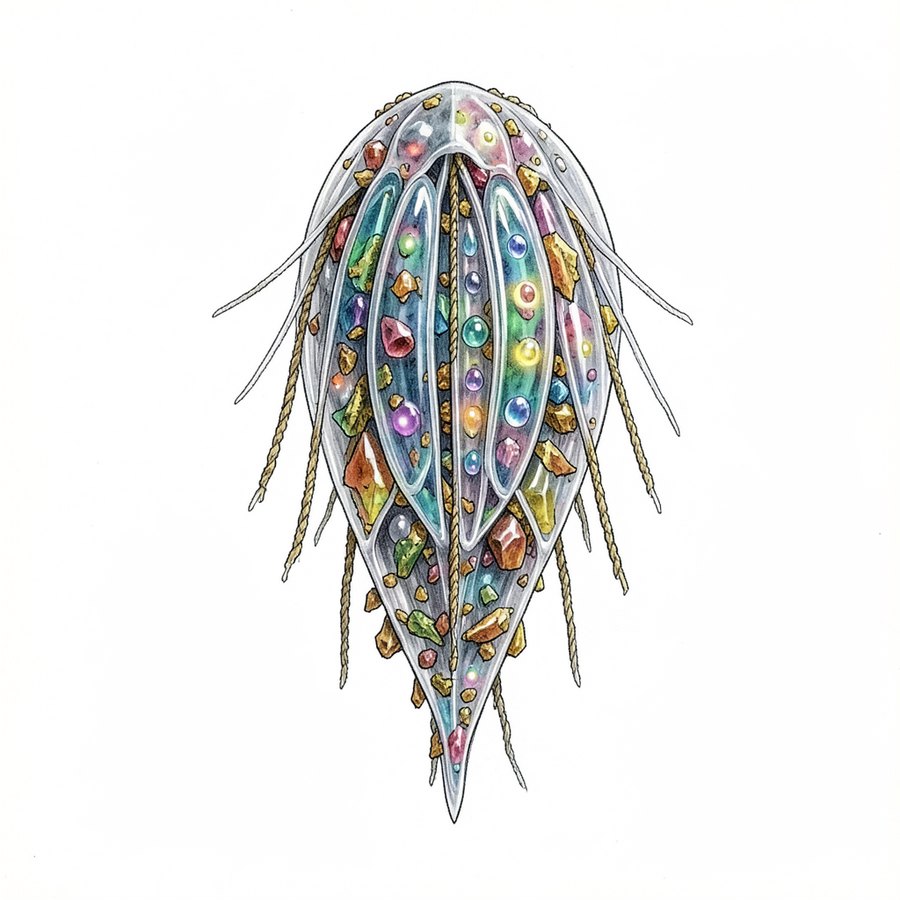
Diamond is carbon pressed deep in the earth into the hardest crystal, which eruptions carry to the surface and cutting turns into scattered light.
What is pressed hard enough for long enough becomes the thing that scratches everything else.
behavior It grows in the dark for ages, rides to the surface in a few hours of eruption, and then outlasts everything it is set into.
What pressure has made something in you harder and clearer than it would have become alone?
I Dissection
Each organ answers one question about the idea. The framed one, its boundary, is the dominant organ: the being's class, the one the idea could not lose and stay itself.
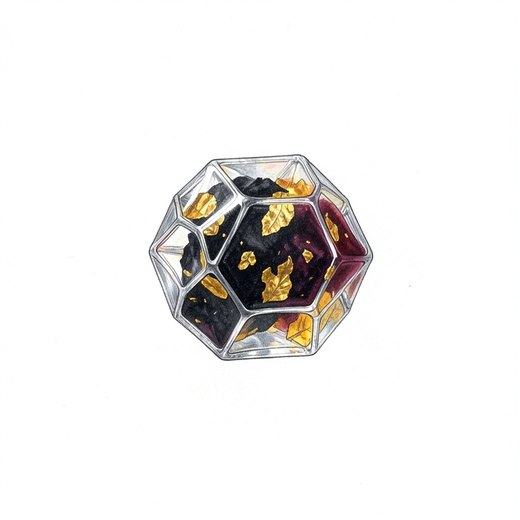
Fig. 1. Kernel
Tetrahedral lattice
Which premise, if it were false, would kill this idea?
Diamond is pure carbon in which every atom is bound to four neighbours at the corners of a tetrahedron, a lattice so tight that it is the hardest natural substance.1
drawn as: tetrahedral lattice · view: transparent
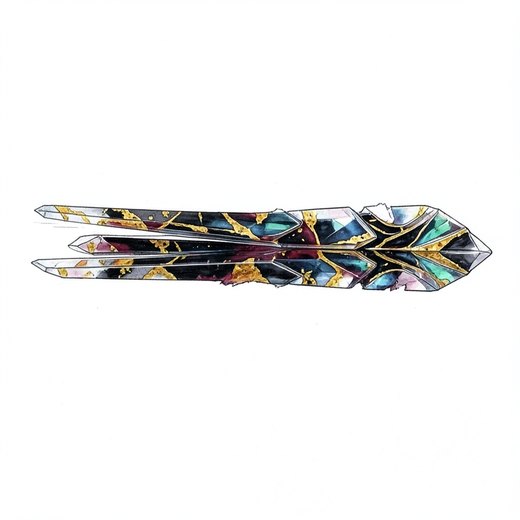
Fig. 2. Boundary
Scratch hardness
❦ dominant organWhat sets it apart from what it is not, and how does it keep that distinction?
It scratches every other mineral and stands at ten, the top of the scale of hardness, and the Greeks named it adamas, the unconquerable.2
drawn as: scratch hardness · view: in situ
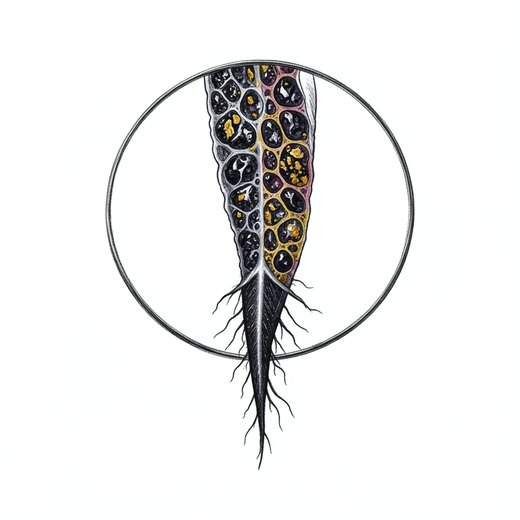
Fig. 3. Intake
Cratonic keel
What must it feed on to work? What has to be present, noticed or supplied?
It feeds on carbon carried down into the mantle on old sea floor or held there since the earth formed, in the roots of the oldest continents 150 kilometres down or more.3
drawn as: cratonic keel · view: microscope
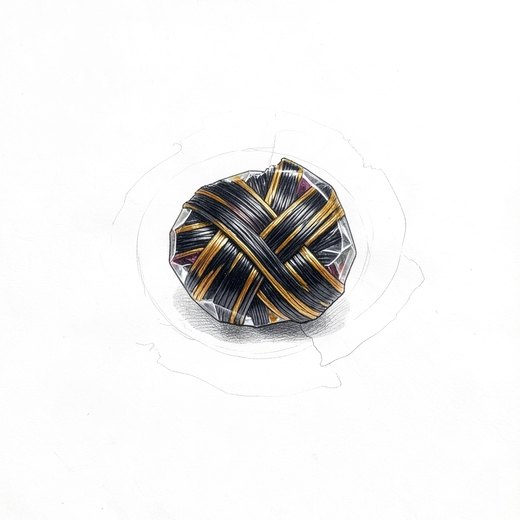
Fig. 4. Mechanism
Lithostatic pressure
How does it turn what it takes in into what it gives out?
Under the weight of the rock above, at some fifty thousand times the pressure of the air and over a thousand degrees, carbon atoms are forced into their densest order and the crystal grows layer by layer.3
drawn as: lithostatic pressure · view: at work
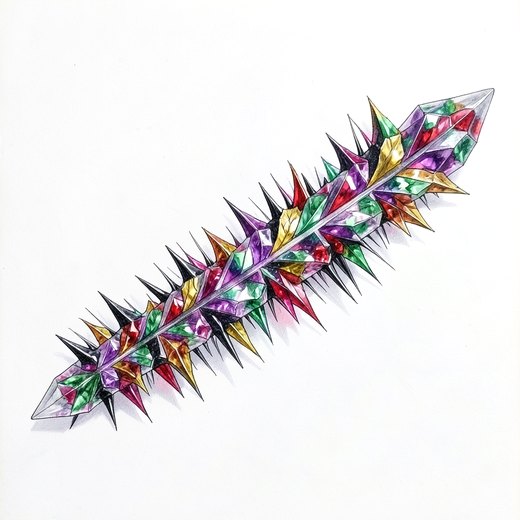
Fig. 5. Output
Brilliant cut
What does it make possible, visible or knowable?
Cut into many facets, it bends white light and splits it into flashes of colour, the fire for which it is prized.4
drawn as: brilliant cut · view: transparent
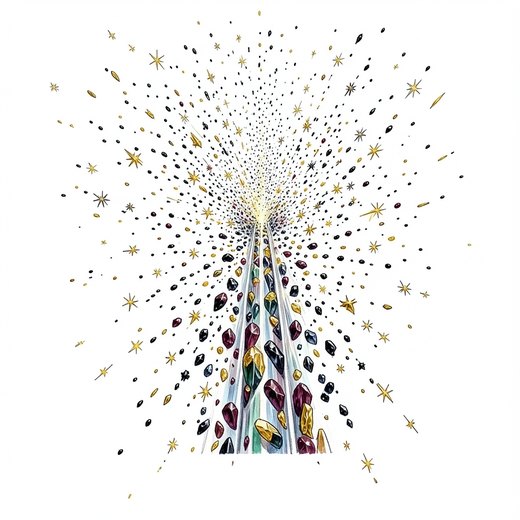
Fig. 6. Dispersal
Diatreme
What part of it travels into other minds, ideas and fields, and by what vector?
Kimberlite eruptions carry it up from the mantle in hours, and it travels in thought as the promise of what lasts forever, the stone of the engagement ring.3, 5
drawn as: diatreme · view: magnified
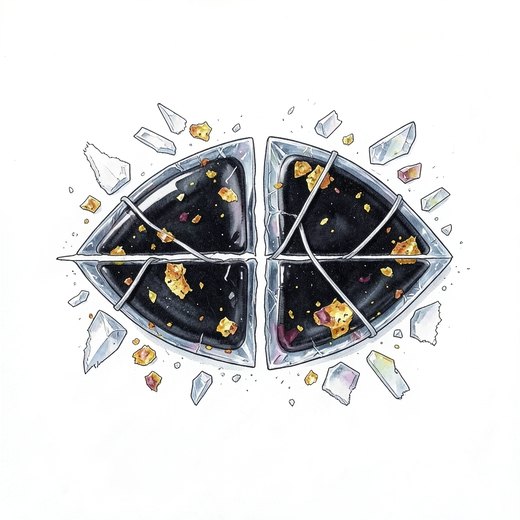
Fig. 7. Decay
Cleavage plane
What can it not digest, where does it fail, and what does it leave behind for others?
Hard as it is, it is brittle, and a sharp blow along its crystal planes splits it clean. Flawed stones and splinters are crushed into grit for saws and drills.3
drawn as: cleavage plane · view: pressed
II Meaning associations
No relations recorded yet.
descent membership food web resemblance or friction
Lineage
A founder, dissected by hand.
Kin
same kind in Roget Archipelago, Ash, Clay, Cloud, Erosion, Fire, Frost, Lake, Rain, River, Salt, Sand, Storm, Wind
same kind in Wilkins Amber, Ash, Clay, Petrification, Salt, Sand
same kind in WordNet Amber, Ash, Clay, Salt, Sand
same kind in Llull Amber, Archipelago, Ash, Clay, Cloud, Emergence, Entanglement, Entropy, Erosion, Fire, Frost, Iridescence, Lake, Petrification, Rain, Reflection, Resonance, Resonance (second reading), River, Salt, Sand, Storm, Weightlessness, Wind, Winter, Self-Ending Order
same phylum Fear, Fire, Glossolalia, Oblivion, Spring, Storm, Volition, Rushmaker, Self-Ending Order
same dominant organ Amber, Aura, Cloud, Equinox, Frost, Possession, Reflection, Solitude, Threshold, Tongue Horizon, The Shared Cell
Genome
- pressure
- carbon
- hardness
- brilliance
- depth also in Lake
III In the world
Echoes
- an engagement ring
- the Big Hole at Kimberley
- the Koh-i-Noor
- a diamond-tipped saw
IV Record
How it was drawn
its draw 2, a point in the morphospace (laws §8), drawn by flux-2-klein-4b.safetensors.
| axis | value | |
|---|---|---|
| book | pathemata | |
| symmetry | asymmetric | |
| organization | solitary | |
| silhouette | columnar | |
| scale | hand | |
| proportion | tapering | |
| growth | encrusted | |
| articulation | telescoping latent | |
| openness | hollow latent | |
| skeleton | spicules latent | |
| locomotion | jetting latent | |
| pattern | reticulate latent | |
| coloration | nuptial | |
| substance | crystal | |
| surface | mottled | |
| palette | obsidian | |
| luminosity | points | |
| transparency | layered latent | |
| gesture | dissolves | |
| unity | unmarked latent | |
| modality | unmarked latent | |
| causation | unmarked latent | |
| determinacy | dissolving latent | |
| fusion | becoming | |
| anomaly | sideways | |
| graft | quipu | |
| technique | silverpoint | |
| viewpoint | below | |
| value | chiaroscuro latent | |
| balance | top heavy latent | |
| density | graded detail | |
| rhythm | regular latent | |
| saturation | muted latent | |
| appendages | bladders | |
| anchor (body) | a diatom, a glass shell in two halves perforated with ordered pores | |
| anchor (detail) | a comb jelly, an oval glassy body with eight rows of beating iridescent combs |
Sources
- W. H. Bragg and W. L. Bragg, The Structure of the Diamond (Proceedings of the Royal Society A, 1913)
- Pliny the Elder, Natural History (77 CE), book 37, on adamas
- Robert M. Hazen, The Diamond Makers (1999)
- Marcel Tolkowsky, Diamond Design: A Study of the Reflection and Refraction of Light in a Diamond (1919)
- Edward Jay Epstein, The Rise and Fall of Diamonds: The Shattering of a Brilliant Illusion (1982)
❦